1. African American Soldiers and Sailors – A treasure trove of information pertaining to United States Colored Troops, black sailors, and enslaved African Americans who sought freedom in North Carolina during the Civil War.
2. Civil War Emancipation – This blog should be downright spectacular, considering that it is authored by Dr. Donald Shaffer, who wrote a book that made it onto this blog’s Top 12 Books: USCT Edition – After the Glory: The Struggles of Black Civil War Veterans. Dr. Shaffer’s stated purpose in maintaining his blog is to "1) commemorate important milestones in emancipation in the Civil War as their 150th anniversary arrives in the sesquicentennial; 2) discuss noteworthy publications on this subject; 3) comment on current events related to the Civil War and emancipation; 4) plus write on whatever else comes to mind that is appropriate."
3. Jubilo! The Emancipation Century – This blog’s stated purpose is to "cover the following topics: abolition, slavery, the Civil War, emancipation, the Reconstruction, and the Nadir."
4. The USCT Chronicle – Blogger Angela Y. Walton-Raji vows to "tell some of the missing stories of the Black Union Soldiers from Tippah County Mississippi, from Giles County Tennessee, from the states west of the Mississippi, Arkansas, Kansas, and Indian Territory."
Also, as I hope should go without saying, Dr. Brooks D. Simpson has created a new blog called Crossroads which has leapt into the forefront of the best Civil War blogs out there (pretty astounding when you consider he launched the blog in December…overachiever). It even made the list of the Top 30 Civil War Blogs by Onlincourses.net.
And, while we’re on the topic of said list, I should hasten to add that this here blog was chosen to be among the top 30 as well, which is a tremendous honor.
If you had told me when I was 18 years old and devouring books like Return to Bull Run: The Campaign and Battle of Second Manassas and Let Us Have Peace: Ulysses S. Grant and the Politics of War and Reconstruction, 1861-1868 that my name would appear on a list with both of the pre-eminent historians who wrote those books, I would have told you to lay off the hash pipe and get a real job.
Now that this has become a reality, I can only be grateful for all of you who take the time out of your busy lives to read this blog.
All I can say is thank you.

Thursday, January 27, 2011


Tuesday, January 25, 2011
“Beast” Butler’s Finest Speech
History has not been kind to Benjamin Franklin Butler. In most general histories of the Civil War Butler comes across as the conniving political general who blundered his way to prominence, stole spoons, and insulted Southern womanhood to the point where Jeff Davis put a bounty on his head and he was referred to as “Beast.” Like him or not, however, Butler had a profound influence on the trajectory of the war. While most people are familiar with his famous “contraband” order at Fortress Monroe, his capture and subsequent occupation of New Orleans, and his tenure as the commander of the Army of the James, some may not be as familiar with his post-war career in the United States Congress during Reconstruction.

It was in that body, during the debate over the Civil Rights Act of 1875, that Butler explained his transformation from a Democrat who supported Breckinridge during the election of 1860 and had very convention views on slavery, to a Radical Republican and supporter of equal rights for African Americans. By this point in his career, Butler always drew large crowds because his biting wit and sarcasm could enflame his Southern colleagues and you never quite knew when his grandiloquence would cause an uproar. (One of the finest examples of this kind of rhetoric came when he critiqued Southern objections to the act – “What are the objections made to this bill? The first objection stated on the other side is that this bill establishes social equality. By no means, by no means…I am inclined to think that the only equality the blacks ever have in the South is social equality; for I understand the highest exhibition of social equality is communication between the sexes…”)
On this particular day, however, Butler hearkened back to Thursday, September 29, 1864 – the Battle New Market Heights. According to Butler, it was the bravery he witnessed on that field of honor that convinced him that African Americans were capable of, and deserving of, equality and the benefits of citizenship. As he addressed the Congress he recalled:
He concluded his remarks with the following admonition:
Let us hope that is not the case as we steam full speed ahead into the Sesquicentennial.
Oh, and do you know how followed up Butler’s speech on the House floor that day? Robert B. Vance -the representative from North Carolina, who also just happened to be the brother of Zebulon Vance.

It was in that body, during the debate over the Civil Rights Act of 1875, that Butler explained his transformation from a Democrat who supported Breckinridge during the election of 1860 and had very convention views on slavery, to a Radical Republican and supporter of equal rights for African Americans. By this point in his career, Butler always drew large crowds because his biting wit and sarcasm could enflame his Southern colleagues and you never quite knew when his grandiloquence would cause an uproar. (One of the finest examples of this kind of rhetoric came when he critiqued Southern objections to the act – “What are the objections made to this bill? The first objection stated on the other side is that this bill establishes social equality. By no means, by no means…I am inclined to think that the only equality the blacks ever have in the South is social equality; for I understand the highest exhibition of social equality is communication between the sexes…”)
On this particular day, however, Butler hearkened back to Thursday, September 29, 1864 – the Battle New Market Heights. According to Butler, it was the bravery he witnessed on that field of honor that convinced him that African Americans were capable of, and deserving of, equality and the benefits of citizenship. As he addressed the Congress he recalled:
I came into command…in Virginia in 1863. I there organized twenty-five regiments, with some that were sent to me, and disciplined them. Still all my brother officers of the regular army said my colored soldiers would not fight; and I felt it was necessary that they should fight to show that their race was capable of the duties of citizens; for one of the highest duties of citizens is to defend their own liberties and their country’s flag and honor. On the 29th of September, 1864, I was ordered by the commanding general…to cross the James River at two points and attack the enemy’s line of works…and there are men on the floor who will remember that day, I doubt not, as I do myself…I went myself with the colored troops, to attack the enemy at New Market Heights, which was the key to the enemy’s flank on the north side of James River. That work was a redoubt built on the top of a hill of some considerable elevation; then running down into a marsh; in that marsh was a brook; then rising again to a plain which gently rolled away toward the river. On that plain, when the flash of dawn was breaking, I placed a column of three thousand colored troops, in close column by division, right in front, with guns at “right shoulder shift.”Butler then goes on to detail the assaults made by his friend Charles J. Paine’s Division upon the New Market Line. As I mentioned before, Butler had a price on his head and therefore did not go forward with his men. When the victory was won, however, he rode to the front and left the following account of the carnage that he witnessed:
I said: “That work must be taken by the weight of your column; not a shot must be fired;” and to prevent their firing I had the caps taken from the nipples of their guns. Then I said, “Your cry, when you charge, will be, ‘Remember Fort Pillow!’” and as the sun rose up in the heavens the order was given, “Forward!” and they marched forward as steadily as if on parade.
It became my painful duty, sir, to follow in the track of that charging column, and there, in a space not wider than the clerk’s desk…lay the dead bodies of five hundred and forty-three of my colored soldiers, slain in defense of their country, and who had laid down their lives to uphold its flag and its honor as a willing sacrifice; and as I rode along among them, guiding my horse this way and that way lest he should profane with his hoofs what seemed to me the sacred dead, and as I looked on their bronzed faces upturned in the shining sun to heaven as if in mute appeal against the wrongs of that country…feeling I had wronged them in the past and believing what was the future of my country towards them…I swore to myself a solemn oath, “May my right hand forget its cunning and my tongue cleave to the roof of my mouth if I ever fail to defend the rights of these men who have given their blood for me and my country this day and for their race forever!” and, God help me, I will keep that oath.In this speech Butler reveals that it was seeing the aftermath of the battle of the New Market Heights that turned him into an ardent supporter of African American rights.
He concluded his remarks with the following admonition:
Now, Mr. Speaker, these men have fought for their country…they have shown themselves our equals in battle; as citizens they are kind, quiet, temperate, laborious; they have shown that they know how to exercise the right of suffrage which we have given to them, for they always vote right; they vote the Republican ticket, and all the powers of death and hell cannot persuade them to do otherwise. They show that they knew more than their masters did, for they always knew how to be loyal. They have industry, they have temperance, they have all the good qualities of citizens, they have bravery, they have culture, they have power, they have eloquence. And who shall say that they shall not have what the Constitution gives them – equal rights!With this stirring conclusion, he took his seat. His vivid depiction of the fighting that took place at New Market Heights and the change it wrought in his thinking makes this one of the most revealing and important speeches that Ben Butler ever gave. After Butler and authors like Joseph T. Wilson, George Washington Williams, and William Wells Brown ceased speaking and writing, the Battle of New Market Heights was virtually forgotten for almost a century.
Let us hope that is not the case as we steam full speed ahead into the Sesquicentennial.
Oh, and do you know how followed up Butler’s speech on the House floor that day? Robert B. Vance -the representative from North Carolina, who also just happened to be the brother of Zebulon Vance.
Friday, January 21, 2011
Book Me, Danno (Please?)

Here’s what I’ve got lined up thus far:
September 23, 2011 – Henrico County - Gateway to Richmond, 1861 – 1865 Symposium
October 13, 2011 – Killer Angels Book Discussion, Tuckahoe Library, Richmond
April 19 – April 22, 2012 – National Council on Public History & Organization of American Historians Joint Meeting: Roundtable Discussion, “Civil War Battlefields: Imagining Possibilities after 150 Years” with Peter Carmichael, Joan Zenzen, Robert Sutton, & Ashley Whitehead
Friday, January 7, 2011
Looking Forward
Well, we’re off and running with the Sesquicentennial and already here in Virginia we’re seeing even more controversy surrounding the way textbooks portray the Civil War era. That being said, I’ve perused the web over the past week and have come up with the following calendar of events that pertain (directly or indirectly) to United States Colored Troops. If I missed anything, please let me know and I will gladly post an update.
February
4 VA Grand Opening of exhibit “An American Turning Point: The Civil War in Virginia”. Virginia Historical Society. 428 North Boulevard http://www.vahistorical.org/civilwar/main.htm
11 VA Lecture, "African Americans in the Civil War," at the Lucy Corr Village, 6680 Lucy Corr Blvd, Chesterfield. 7 pm. Free. 804-751-4946.
12 MD Lecture, “The African American Civil War Experience,” at the National Museum of Civil War Medicine in Frederick. 11 am. Free with museum admission. http://www.civilwarmed.org/ or 301-695-1864.
18-20 FL Reenactment of the Battle of Olustee at the Olustee Battlefield Historic State Park near Lake City. Camps, demonstrations and music all weekend plus artillery night firing Friday evening and battles at 3:30 pm Saturday and 1:30 pm Sunday. $7/person weekend ticket. 877-635-3655 or http://www.floridastateparks.org/.
19 VA Lecture, “African-Americans in the Union Navy,” at the Mariners’ Museum in Newport News. 1 pm. Free with museum admission. 757-596-2222 or http://www.marinersmuseum.org/.
19 VA Film showing, “Glory,” at the Virginia War Museum in Newport News. 1 pm. Free with admission. 757-247-8523.
26 Washington D.C. Association for the Study of African American Life and History. 85th Annual Black History Month 2011 Luncheon and Featured Authors' Event. 1:00 PM. Renaissance Hotel. Guest speakers include historian Lerone Bennett, Jr., Executive Editor Emeritus, Ebony Magazine; event honorary co-chair Dr. Frank Smith, former DC Councilman and current Director of the African American Civil War Memorial Freedom Foundation and Museum.
28 MD Lecture, “African American Surgeons of the Civil War,” at the National Museum of Civil War Medicine in Frederick. 11 am. Free with admission. 301-695-1864 or http://www.civilwarmed.org/.
March
5-6 VA “The Civil War on the James Tour” 9525 Deep Bottom Road www.discoverthejames.com
12 VA Car-caravan tour “1864 Bermuda Hundred Campaign” leaves from Henricus Historical Park, 251 Henricus Park Road, Chester (south of Richmond). 10 am–1 pm. $8. 804-751-4946 or http://www.chesterfieldhistory.com/.
April
9 VA Car-caravan tour, “1864 Bermuda Hundred Campaign,” leaves from Henricus Historical Park, 251 Henricus Park Road, Chester (south of Richmond). 10 am–1 pm. $8. 804-751-4946 or http://www.chesterfieldhistory.com/.
May
21-22 VA Reenactment, “Fort Pocahontas,” camps, demonstrations, fort tours and battles each afternoon at the historic Civil War fort on the James River between Richmond and Williamsburg near Route 5. Latest details: http://www.fortpocahontas.org/.
June
19 VA “Juneteenth” celebration with stories of black sailors in the Union blockade. At the Colonial Courthouse in Gloucester. 2-4 pm. Free. 804-693-2355.
September
23 VA "Henrico County - Gateway to Richmond, 1861 - 1865", 10 a.m. – 5 p.m. Henrico Theatre, 305 E. Nine Mile Road, Highland Springs, 23075. The kickoff event for the Henrico County Sesquicentennial Committee's commemoration, bringing together nationally-renowned authors and experts for a discussion of the crucial role played by Henrico County in the American Civil War. Includes talk on New Market Heights.
24 VA Encampment and Exhibits. 10 a.m. - 3 p.m. Tree Hill farm, 6404 Osborne Turnpike, Henrico, VA 23231. The event will include a ceremony to honor those who were Medal of Honor recipients for valor on Henrico soil and feature living history demonstrations and exhibits from leading Civil War organizations.
24 VA “Voices of Freedom” Program in honor of New Market Heights Medal of Honor Recipient James Gardiner. Gloucester 6509 Main Street. 804-693-2355
29 VA Workshop, “Researching Your African American Ancestors: Genealogy to 1870,” at the Library of Virginia, 800 E Broad St, Richmond. 10 am-noon. Free. Registration required: 804-371-2126.
February
4 VA Grand Opening of exhibit “An American Turning Point: The Civil War in Virginia”. Virginia Historical Society. 428 North Boulevard http://www.vahistorical.org/civilwar/main.htm
11 VA Lecture, "African Americans in the Civil War," at the Lucy Corr Village, 6680 Lucy Corr Blvd, Chesterfield. 7 pm. Free. 804-751-4946.
12 MD Lecture, “The African American Civil War Experience,” at the National Museum of Civil War Medicine in Frederick. 11 am. Free with museum admission. http://www.civilwarmed.org/ or 301-695-1864.
18-20 FL Reenactment of the Battle of Olustee at the Olustee Battlefield Historic State Park near Lake City. Camps, demonstrations and music all weekend plus artillery night firing Friday evening and battles at 3:30 pm Saturday and 1:30 pm Sunday. $7/person weekend ticket. 877-635-3655 or http://www.floridastateparks.org/.
19 VA Lecture, “African-Americans in the Union Navy,” at the Mariners’ Museum in Newport News. 1 pm. Free with museum admission. 757-596-2222 or http://www.marinersmuseum.org/.
19 VA Film showing, “Glory,” at the Virginia War Museum in Newport News. 1 pm. Free with admission. 757-247-8523.
26 Washington D.C. Association for the Study of African American Life and History. 85th Annual Black History Month 2011 Luncheon and Featured Authors' Event. 1:00 PM. Renaissance Hotel. Guest speakers include historian Lerone Bennett, Jr., Executive Editor Emeritus, Ebony Magazine; event honorary co-chair Dr. Frank Smith, former DC Councilman and current Director of the African American Civil War Memorial Freedom Foundation and Museum.
28 MD Lecture, “African American Surgeons of the Civil War,” at the National Museum of Civil War Medicine in Frederick. 11 am. Free with admission. 301-695-1864 or http://www.civilwarmed.org/.
March
5-6 VA “The Civil War on the James Tour” 9525 Deep Bottom Road www.discoverthejames.com
12 VA Car-caravan tour “1864 Bermuda Hundred Campaign” leaves from Henricus Historical Park, 251 Henricus Park Road, Chester (south of Richmond). 10 am–1 pm. $8. 804-751-4946 or http://www.chesterfieldhistory.com/.
April
9 VA Car-caravan tour, “1864 Bermuda Hundred Campaign,” leaves from Henricus Historical Park, 251 Henricus Park Road, Chester (south of Richmond). 10 am–1 pm. $8. 804-751-4946 or http://www.chesterfieldhistory.com/.
May
21-22 VA Reenactment, “Fort Pocahontas,” camps, demonstrations, fort tours and battles each afternoon at the historic Civil War fort on the James River between Richmond and Williamsburg near Route 5. Latest details: http://www.fortpocahontas.org/.
June
19 VA “Juneteenth” celebration with stories of black sailors in the Union blockade. At the Colonial Courthouse in Gloucester. 2-4 pm. Free. 804-693-2355.
September
23 VA "Henrico County - Gateway to Richmond, 1861 - 1865", 10 a.m. – 5 p.m. Henrico Theatre, 305 E. Nine Mile Road, Highland Springs, 23075. The kickoff event for the Henrico County Sesquicentennial Committee's commemoration, bringing together nationally-renowned authors and experts for a discussion of the crucial role played by Henrico County in the American Civil War. Includes talk on New Market Heights.
24 VA Encampment and Exhibits. 10 a.m. - 3 p.m. Tree Hill farm, 6404 Osborne Turnpike, Henrico, VA 23231. The event will include a ceremony to honor those who were Medal of Honor recipients for valor on Henrico soil and feature living history demonstrations and exhibits from leading Civil War organizations.
24 VA “Voices of Freedom” Program in honor of New Market Heights Medal of Honor Recipient James Gardiner. Gloucester 6509 Main Street. 804-693-2355
29 VA Workshop, “Researching Your African American Ancestors: Genealogy to 1870,” at the Library of Virginia, 800 E Broad St, Richmond. 10 am-noon. Free. Registration required: 804-371-2126.
Wednesday, January 5, 2011
Saturday, January 1, 2011
New Year’s Day, 1863

January 1, 1863 (evening).
A happy New Year to civilized people,—mere white folks. Our festival has come and gone, with perfect success, and our good General has been altogether satisfied. Last night the great fires were kept smouldering in the pit, and the beeves were cooked more or less, chiefly more,—during which time they had to be carefully watched, and the great spits turned by main force. Happy were the merry fellows who were permitted to sit up all night, and watch the glimmering flames that threw a thousand fantastic shadows among the great gnarled oaks. And such a chattering as I was sure to hear whenever I awoke that night!
My first greeting to-day was from one of the most stylish sergeants, who approached me with the following little speech, evidently the result of some elaboration:—
"I tink myself happy, dis New Year's Day, for salute my own Cunnel. Dis day las' year I was servant to a Gunnel ob Secesh; but now I hab de privilege for salute my own Cunnel."
That officer, with the utmost sincerity, reciprocated the sentiment.
About ten o'clock the people began to collect by land, and also by water,—in steamers sent by General Saxton for the purpose; and from that time all the avenues of approach were thronged. The multitude were chiefly colored women, with gay handkerchiefs on their heads, and a sprinkling of men, with that peculiarly respectable look which these people always have on Sundays and holidays. There were many white visitors also,—ladies on horseback and in carriages, superintendents and teachers, officers, and cavalry-men. Our companies were marched to the neighborhood of the platform, and allowed to sit or stand, as at the Sunday services; the platform was occupied by ladies and dignitaries, and by the band of the Eighth Maine, which kindly volunteered for the occasion; the colored people filled up all the vacant openings in the beautiful grove around, and there was a cordon of mounted visitors beyond. Above, the great live-oak branches and their trailing moss; beyond the people, a glimpse of the blue river.
The services began at half past eleven o'clock, with prayer by our chaplain, Mr. Fowler, who is always, on such occasions, simple, reverential, and impressive. Then the President's Proclamation was read by Dr. W. H. Brisbane, a thing infinitely appropriate, a South Carolinian addressing South Carolinians; for he was reared among these very islands, and here long since emancipated his own slaves. Then the colors were presented to us by the Rev. Mr. French, a chaplain who brought them from the donors in New York. All this was according to the programme. Then followed an incident so simple, so touching, so utterly unexpected and startling, that I can scarcely believe it on recalling, though it gave the keynote to the whole day. The very moment the speaker had ceased, and just as I took and waved the flag, which now for the first time meant anything to these poor people, there suddenly arose, close beside the platform, a strong male voice (but rather cracked and elderly), into which two women's voices instantly blended, singing, as if by an impulse that could no more be repressed than the morning note of the song-sparrow.—
"My Country, 'tis of thee, Sweet land of liberty, Of thee I sing!"
People looked at each other, and then at us on the platform, to see whence came this interruption, not set down in the bills. Firmly and irrepressibly the quavering voices sang on, verse after verse; others of the colored people joined in; some whites on the platform began, but I motioned them to silence. I never saw anything so electric; it made all other words cheap; it seemed the choked voice of a race at last unloosed. Nothing could be more wonderfully unconscious; art could not have dreamed of a tribute to the day of jubilee that should be so affecting; history will not believe it; and when I came to speak of it, after it was ended, tears were everywhere. If you could have heard how quaint and innocent it was! Old Tiff and his children might have sung it; and close before me was a little slave-boy, almost white, who seemed to belong to the party, and even he must join in. Just think of it!—the first day they had ever had a country, the first flag they had ever seen which promised anything to their people, and here, while mere spectators stood in silence, waiting for my stupid words, these simple souls burst out in their lay, as if they were by their own hearths at home! When they stopped, there was nothing to do for it but to speak, and I went on; but the life of the whole day was in those unknown people's song.
Receiving the flags, I gave them into the hands of two fine-looking men, jet black, as color-guard, and they also spoke, and very effectively,—Sergeant Prince Rivers and Corporal Robert Sutton. The regiment sang "Marching Along," and then General Saxton spoke, in his own simple, manly way, and Mrs. Francis D. Gage spoke very sensibly to the women, and Judge Stickney, from Florida, added something; then some gentleman sang an ode, and the regiment the John Brown song, and then they went to their beef and molasses. Everything was very orderly, and they seemed to have a very gay time. Most of the visitors had far to go, and so dispersed before dress-parade, though the band stayed to enliven it. In the evening we had letters from home, and General Saxton had a reception at his house, from which I excused myself; and so ended one of the most enthusiastic and happy gatherings I ever knew. The day was perfect, and there was nothing but success.
Tuesday, December 28, 2010
Top 12 Books: USCT Edition
Today I had the pleasure of reading Eric Wittenberg’s latest post over at his blog regarding what he considers the top 12 Civil War books of all time. Eric was inspired by Glen LaFantasie, who wrote his own top 12 list which you can find here. This, in turn, inspired me to put together my own list of what I think are the top 12 books about United States Colored Troops (although I should hasten to add that I am in no way putting myself in the same category as Wittenberg or LaFantasie). Since the literature pertaining to black soldiers is not as varied as Civil War literature in general, I will refrain from using the same constraints that both experts placed upon themselves in their selections.
I’m sure that some of you out there may disagree with my choices and, if that is the case, I’d love to hear your opinions as to which book you think should have made the list (but trust me – narrowing the selection to 12 was a very difficult process).
Now, without further ado, here is my top 12 list:
12. The Black Civil War Soldiers of Illinois: The Story of the Twenty-ninth U.S. Colored Infantry by Edward A. Miller, Jr. Published by the University of South Carolina Press in 1998, this is one of the finest and most complete regimental histories of any USCT unit yet written. Dr. Miller consulted pension records, regimental papers, reports, and letters to trace the history of the 29th USCI (the only USCT unit raised in Illinois) from its recruitment in late 1863 through its combat experience with the Army of the Potomac, where it served in the rear guard during the Overland Campaign and finally saw action in the infamous Battle of the Crater. Miller goes on to chronicle the 29th’s consolidation into the 25th Army Corps and its service in the Appomattox Campaign and postwar service in Texas. By examining the extant records and looking at the demographics of the men who served in the unit, Miller paints a nearly complete picture of a USCT regiment in camp and on the battlefield.
11. The Black Phalanx: A History of the Negro Soldiers of the United States in the Wars of 1775-1812, 1861-‘65 by Joseph T. Wilson. This remarkable work was written by a veteran of both the 2nd Louisiana Native Guard and the 54th Massachusetts, and was first published in 1887 (when it sold for a whopping $3.00). Part II of the book offered the first history of African American service during the Civil War, and Wilson did an admirable job of compiling as many contemporary sources as he could in this volume (which is all the more interesting considering he was living in Virginia when he wrote the book). Wilson detailed the pervasive prejudice against black troops, their heroism on the field of battle, atrocities committed by Confederate soldiers against USCTs, and even compiled a list of black Medal of Honor recipients. As is the case when anyone is writing on a subject for the first time, The Black Phalanx serves as a compilation of source material rather than a comprehensive analysis. That being said, it is still very much worth reading.
10. Campfires of Freedom: The Camp Life of Black Soldiers During the Civil War by Keith P. Wilson. This is hands down one of the most fascinating books I have read on the Civil War, let alone on African American soldiers. I’ve always been interested in the life of the common soldier, and Wilson’s work provides a detailed look at the camp life of black soldiers. The book offers a plethora of fascinating and little known facts (the 54th Massachusetts had a glee club?) and looks at training, discipline, the religious life of black soldiers and chaplains, and how the soldiers chose to spend their free time. Wilson – a native of Australia – says that the purpose of his book was to “describe the soldiers’ lives in their camps…bring into focus the emotional texture of military life, to describe the dreams, aspirations, ambitions, and desires of the common soldier…[and] to analyze the process of cultural change that occurred within the army camps” (p. xiii). The result is a fascinating work that any Civil War buff will want on their shelf.
9. After the Glory: The Struggles of Black Civil War Veterans by Donald R. Shaffer. This 2004 offering from the University Press of Kansas takes a look at what happened to black Union veterans after the cessation of hostilities. Shaffer's work is based on a random sample of the postwar experience of 1,000 ordinary black soldiers, a look at 200 African American veterans involved in "notable activities" after 1865, and a special census taken in 1890 of surviving black veterans. The result is a complex tapestry of mingled hope, achingly slow progress, and the ugly realities of post war racism. Required reading for a complete understanding of the USCT experience.
8. A Regiment of Slaves: The 4th United States Colored Infantry, 1863 –1866 by Edward G. Longacre. Perhaps this book made it onto my list because it details the history of a unit that won its laurels at New Market Heights (four Medals of Honor went to the men of the 4th) and included the inimitable Christian Fleetwood. That said, however, the 4th USCI is certainly a very worthy topic for a regimental history. Not only did the 4th rack up an impressive combat record, it is also noteworthy for its social make up. Organized in Baltimore in the summer of 1863, the 4th USCI consisted of free men such as Christian Fleetwood (who read Greek, Latin, French, and Spanish) and former slaves, which presented a recruiting problem in a loyal state that still maintained the institution of slavery. Still, the 4th participated in the opening battles around Petersburg, was held in reserve at the Crater, helped construct the Dutch Gap canal, and won fame on the fields of New Market Heights. The unit took part in the expedition against Fort Fisher before being mustered out in Washington in 1866 (where Company E posed for one of the most iconic images of United States Colored Troops ever taken). Longacre does an admirable job and proves that there is ample source material sufficient to chronicle USCT units if you do enough digging.
7. Army Life in a Black Regiment by Thomas Wentworth Higginson. Written by a militant abolitionist turned officer of the 1st South Carolina (later the 33rd USCT), this book was originally a series of essays that made it into book form in 1870. Higginson was hell bent on proving that former slaves could be turned into the equals of any white unit fielded by the Union army, and that military service was a key first step to black citizenship . The book has many high points such as Higginson’s account of reading the Emancipation Proclamation to his men and it contains eloquent observations such as his concluding sentence – “It was their demeanor under arms that shamed the nation into recognizing them as men.” While Higginson’s observations may seem outdated and his paternalistic attitude may grate against modern conceptions of race and equality, the reader should keep in mind that Higginson put himself at great risk during the war, since the Confederates would not have hesitated to make an example of an officer in command of black troops who hailed from Massachusetts and had fervently supported John Brown.
6. Freedom For Themselves: North Carolina’s Black Soldiers in the Civil War Era by Richard M. Reid. This 2008 work takes on the ambitious task of relating the history of four of the five African American units raised in North Carolina – the 35th, 36th, and 37th USCI and the 14th USCHA. Reid states that "the real value of this study lies in the fact that the activities, abilities, and utilization of these four regiments were sufficiently varied to encompass the experiences of most black soldiers" (326, 328). Mastering just about all of the primary source material on these four units, Reid not only gives a masterful account of their military service but he also delves into the realm of social history with a fascinating chapter that focuses on what happened to the service member’s families, especially those who sought shelter at the freedmen’s colony on Roanoke Island. Reid also examines what happened to these soldiers after the war during Reconstruction and reviews how veterans adjusted to life in a state that tragically fell under the control of former Confederates.
5. A Grand Army of Black Men: Letters From African American Soldiers in the Union Army, 1861-1865, edited by Edwin S. Redkey. Redkey’s 1992 compilation of 129 letters written to black and abolitionist newspapers forever put to rest Bell Wiley’s lament of a “dearth of letters written by the 200,000 blacks who donned the blue.” Redkey collected soldier letters written to the Christian Recorder, The Weekly Anglo-African, the Pine and Palm and other abolitionist newspapers from the period. Each chapter contains a substantial introduction and each letter or part of a letter is headed by a brief paragraph that gives essential information about the author and the events chronicled in the letter. The letters have a running theme of how African American soldiers saw soldiering as an opportunity to “elevate” their race and earn the rights and benefits of citizenship. They are often proud of their accomplishments, indignant at injustices that sprang from the Confederate army as well as their own, and confident of ultimate success. Noah Andre Trudeau mentions in the beginning of his chronicle of USCTs that Redkey’s book was a major influence upon his writing. The only down side to this otherwise marvelous collection is the unavoidable reality that letters written to newspaper editors were only written by the small portion of USCTs who could read and write. Furthermore, soldiers writing to their local newspapers tended to put a positive spin on their experiences and tell the readers what they already wanted to hear. Thus, there is a substantial portion of United States Colored Troops whose voices will remain forever silent.
4. Black Soldiers in Blue: African American Troops in the Civil War Era, edited by John David Smith. This wonderful collection of 14 essays includes selections from authorities such as William Glenn Robertson, Noah Andre Trudeau, the late Art Bergeron, John Cimprich, and Keith Wilson among others. Some of the essays are short battle histories of the fighting that took place at Port Hudson, Milliken’s Bend, Olustee, the Crater, New Market Heights, and Saltville. Other essays examine the lives of USCT chaplains, black recruitment efforts in the Mississippi Valley, USCTs who fought in Tennessee, and an outstanding survey of the fortunes of the United States Colored Cavalry. While each scholarly piece can stand on its own, the essays are in chronological order and if the book is read from cover to cover this work will serve as an outstanding overview of black Union soldiers.
3. Like Men of War: Black Troops in the Civil War, 1862-1865 by Noah Andre Trudeau. Coming in at number three is Noah Andre Trudeau’s now-classic 1998 fighting history of the USCT. Trudeau did an amazing amount of research, taking up where Redkey left off by delving deep into the extant collection of letters, diaries, and pension records left by black troops and their officers. The result is a vivid narrative that brims with firsthand accounts and should forever put to rest the misguided notion that African Americans were passive and scarcely lifted a finger to secure their own freedom (an idea touted by William E. Woodward in 1928 and one that is still popular in Neo-Confederate and Southern Heritage circles). Unfortunately this book never achieved the acclaim of some of Trudeau’s other works. Perhaps the Sesquicentennial will remedy that.
2. Forged in Battle: The Civil War Alliance of Black Soldiers and White Officers by Joseph T. Glatthaar. Joe Glatthaar had the good fortune of publishing his study on the relationship between black enlisted men and their white officers right on the heels of the motion picture Glory. That being said, it has landed in the number two slot for a reason – it is the most detailed analysis yet written on said relationship. Glatthaar dispels the notion that all white officers who led black troops were mini Thomas Wentworth Higginsons or Robert Gould Shaws. Many officers thought poorly of their men, held the same racist views that permeated American society at the time, and could be extremely harsh on their men for what most would consider minor infractions. Moreover, many white enlisted men only sought the opportunity to serve in the USCT because they desired higher rank and the resultant pay increase that came with it (Glatthaar quotes one Illinois soldier who quipped, “I would drill a company of alligators for a hundred and twenty [dollars] a month”). However, the process by which white men were recruited and tested shows that, no matter what their motivations, the USCT provided some of the best trained officers to emerge from the Union war effort. The book goes on to examine recruitment, training, dealing with the racism and opposition, and the test of battle that many of these men faced. The book ends with an examination of occupation duty and the postwar careers of some of the men who fought in the USCT. While Glatthaar clearly achieved his stated goal of examining “the inner workings of…black commands, to investigate conduct, attitudes, and experiences among the participants” (p. x), my main quibble is that he rarely mentions the Army of the James, which just happened to be the fighting force with the largest concentration of black soldiers in the entire Union army. Why he did not investigate this neglected army is beyond me, but the book is still one of the very best in its field.
1. The Sable Arm: Negro Troops in the Union Army, 1861-1865 by Dudley Taylor Cornish. It should come as no surprise that this book is still the standard introductory work on the subject of United States Colored Troops and that, even though it is 54 years old, it still has not been surpassed. When the book debuted in 1956, the struggle for civil rights was still raging and many of the popular titles on the Civil War made no mention of black troops whatsoever. Cornish’s assertion that “As a soldier in the Union army, the Negro soldier proved his manhood and established a strong claim to equality of treatment and opportunity” may have ruffled some feathers, but he provided the necessary data and statistical evidence to back up his claim. The book was well received in the scholarly community, and T. Harry Williams asserted that “The Sable Arm must be rated as a major study that throws new illumination on a neglected side of the war.” In the book, Cornish vividly describes the various forces and unique individuals who compelled the Lincoln Administration to adopt the controversial policy of recruiting free blacks and runaway slaves for military service, the formation of the 166 regiments that made up the United States Colored Troops , and the performance of those units in combat. Cornish set the bar very high and blazed a trail for those who devote themselves to the study of the African American contribution to Union victory. If you wish to deepen your understanding of the USCT, start by reading The Sable Arm. I promise you, you won’t regret it.
I’m sure that some of you out there may disagree with my choices and, if that is the case, I’d love to hear your opinions as to which book you think should have made the list (but trust me – narrowing the selection to 12 was a very difficult process).
Now, without further ado, here is my top 12 list:
12. The Black Civil War Soldiers of Illinois: The Story of the Twenty-ninth U.S. Colored Infantry by Edward A. Miller, Jr. Published by the University of South Carolina Press in 1998, this is one of the finest and most complete regimental histories of any USCT unit yet written. Dr. Miller consulted pension records, regimental papers, reports, and letters to trace the history of the 29th USCI (the only USCT unit raised in Illinois) from its recruitment in late 1863 through its combat experience with the Army of the Potomac, where it served in the rear guard during the Overland Campaign and finally saw action in the infamous Battle of the Crater. Miller goes on to chronicle the 29th’s consolidation into the 25th Army Corps and its service in the Appomattox Campaign and postwar service in Texas. By examining the extant records and looking at the demographics of the men who served in the unit, Miller paints a nearly complete picture of a USCT regiment in camp and on the battlefield.
11. The Black Phalanx: A History of the Negro Soldiers of the United States in the Wars of 1775-1812, 1861-‘65 by Joseph T. Wilson. This remarkable work was written by a veteran of both the 2nd Louisiana Native Guard and the 54th Massachusetts, and was first published in 1887 (when it sold for a whopping $3.00). Part II of the book offered the first history of African American service during the Civil War, and Wilson did an admirable job of compiling as many contemporary sources as he could in this volume (which is all the more interesting considering he was living in Virginia when he wrote the book). Wilson detailed the pervasive prejudice against black troops, their heroism on the field of battle, atrocities committed by Confederate soldiers against USCTs, and even compiled a list of black Medal of Honor recipients. As is the case when anyone is writing on a subject for the first time, The Black Phalanx serves as a compilation of source material rather than a comprehensive analysis. That being said, it is still very much worth reading.
10. Campfires of Freedom: The Camp Life of Black Soldiers During the Civil War by Keith P. Wilson. This is hands down one of the most fascinating books I have read on the Civil War, let alone on African American soldiers. I’ve always been interested in the life of the common soldier, and Wilson’s work provides a detailed look at the camp life of black soldiers. The book offers a plethora of fascinating and little known facts (the 54th Massachusetts had a glee club?) and looks at training, discipline, the religious life of black soldiers and chaplains, and how the soldiers chose to spend their free time. Wilson – a native of Australia – says that the purpose of his book was to “describe the soldiers’ lives in their camps…bring into focus the emotional texture of military life, to describe the dreams, aspirations, ambitions, and desires of the common soldier…[and] to analyze the process of cultural change that occurred within the army camps” (p. xiii). The result is a fascinating work that any Civil War buff will want on their shelf.
9. After the Glory: The Struggles of Black Civil War Veterans by Donald R. Shaffer. This 2004 offering from the University Press of Kansas takes a look at what happened to black Union veterans after the cessation of hostilities. Shaffer's work is based on a random sample of the postwar experience of 1,000 ordinary black soldiers, a look at 200 African American veterans involved in "notable activities" after 1865, and a special census taken in 1890 of surviving black veterans. The result is a complex tapestry of mingled hope, achingly slow progress, and the ugly realities of post war racism. Required reading for a complete understanding of the USCT experience.
8. A Regiment of Slaves: The 4th United States Colored Infantry, 1863 –1866 by Edward G. Longacre. Perhaps this book made it onto my list because it details the history of a unit that won its laurels at New Market Heights (four Medals of Honor went to the men of the 4th) and included the inimitable Christian Fleetwood. That said, however, the 4th USCI is certainly a very worthy topic for a regimental history. Not only did the 4th rack up an impressive combat record, it is also noteworthy for its social make up. Organized in Baltimore in the summer of 1863, the 4th USCI consisted of free men such as Christian Fleetwood (who read Greek, Latin, French, and Spanish) and former slaves, which presented a recruiting problem in a loyal state that still maintained the institution of slavery. Still, the 4th participated in the opening battles around Petersburg, was held in reserve at the Crater, helped construct the Dutch Gap canal, and won fame on the fields of New Market Heights. The unit took part in the expedition against Fort Fisher before being mustered out in Washington in 1866 (where Company E posed for one of the most iconic images of United States Colored Troops ever taken). Longacre does an admirable job and proves that there is ample source material sufficient to chronicle USCT units if you do enough digging.
7. Army Life in a Black Regiment by Thomas Wentworth Higginson. Written by a militant abolitionist turned officer of the 1st South Carolina (later the 33rd USCT), this book was originally a series of essays that made it into book form in 1870. Higginson was hell bent on proving that former slaves could be turned into the equals of any white unit fielded by the Union army, and that military service was a key first step to black citizenship . The book has many high points such as Higginson’s account of reading the Emancipation Proclamation to his men and it contains eloquent observations such as his concluding sentence – “It was their demeanor under arms that shamed the nation into recognizing them as men.” While Higginson’s observations may seem outdated and his paternalistic attitude may grate against modern conceptions of race and equality, the reader should keep in mind that Higginson put himself at great risk during the war, since the Confederates would not have hesitated to make an example of an officer in command of black troops who hailed from Massachusetts and had fervently supported John Brown.
6. Freedom For Themselves: North Carolina’s Black Soldiers in the Civil War Era by Richard M. Reid. This 2008 work takes on the ambitious task of relating the history of four of the five African American units raised in North Carolina – the 35th, 36th, and 37th USCI and the 14th USCHA. Reid states that "the real value of this study lies in the fact that the activities, abilities, and utilization of these four regiments were sufficiently varied to encompass the experiences of most black soldiers" (326, 328). Mastering just about all of the primary source material on these four units, Reid not only gives a masterful account of their military service but he also delves into the realm of social history with a fascinating chapter that focuses on what happened to the service member’s families, especially those who sought shelter at the freedmen’s colony on Roanoke Island. Reid also examines what happened to these soldiers after the war during Reconstruction and reviews how veterans adjusted to life in a state that tragically fell under the control of former Confederates.
5. A Grand Army of Black Men: Letters From African American Soldiers in the Union Army, 1861-1865, edited by Edwin S. Redkey. Redkey’s 1992 compilation of 129 letters written to black and abolitionist newspapers forever put to rest Bell Wiley’s lament of a “dearth of letters written by the 200,000 blacks who donned the blue.” Redkey collected soldier letters written to the Christian Recorder, The Weekly Anglo-African, the Pine and Palm and other abolitionist newspapers from the period. Each chapter contains a substantial introduction and each letter or part of a letter is headed by a brief paragraph that gives essential information about the author and the events chronicled in the letter. The letters have a running theme of how African American soldiers saw soldiering as an opportunity to “elevate” their race and earn the rights and benefits of citizenship. They are often proud of their accomplishments, indignant at injustices that sprang from the Confederate army as well as their own, and confident of ultimate success. Noah Andre Trudeau mentions in the beginning of his chronicle of USCTs that Redkey’s book was a major influence upon his writing. The only down side to this otherwise marvelous collection is the unavoidable reality that letters written to newspaper editors were only written by the small portion of USCTs who could read and write. Furthermore, soldiers writing to their local newspapers tended to put a positive spin on their experiences and tell the readers what they already wanted to hear. Thus, there is a substantial portion of United States Colored Troops whose voices will remain forever silent.
4. Black Soldiers in Blue: African American Troops in the Civil War Era, edited by John David Smith. This wonderful collection of 14 essays includes selections from authorities such as William Glenn Robertson, Noah Andre Trudeau, the late Art Bergeron, John Cimprich, and Keith Wilson among others. Some of the essays are short battle histories of the fighting that took place at Port Hudson, Milliken’s Bend, Olustee, the Crater, New Market Heights, and Saltville. Other essays examine the lives of USCT chaplains, black recruitment efforts in the Mississippi Valley, USCTs who fought in Tennessee, and an outstanding survey of the fortunes of the United States Colored Cavalry. While each scholarly piece can stand on its own, the essays are in chronological order and if the book is read from cover to cover this work will serve as an outstanding overview of black Union soldiers.
3. Like Men of War: Black Troops in the Civil War, 1862-1865 by Noah Andre Trudeau. Coming in at number three is Noah Andre Trudeau’s now-classic 1998 fighting history of the USCT. Trudeau did an amazing amount of research, taking up where Redkey left off by delving deep into the extant collection of letters, diaries, and pension records left by black troops and their officers. The result is a vivid narrative that brims with firsthand accounts and should forever put to rest the misguided notion that African Americans were passive and scarcely lifted a finger to secure their own freedom (an idea touted by William E. Woodward in 1928 and one that is still popular in Neo-Confederate and Southern Heritage circles). Unfortunately this book never achieved the acclaim of some of Trudeau’s other works. Perhaps the Sesquicentennial will remedy that.
2. Forged in Battle: The Civil War Alliance of Black Soldiers and White Officers by Joseph T. Glatthaar. Joe Glatthaar had the good fortune of publishing his study on the relationship between black enlisted men and their white officers right on the heels of the motion picture Glory. That being said, it has landed in the number two slot for a reason – it is the most detailed analysis yet written on said relationship. Glatthaar dispels the notion that all white officers who led black troops were mini Thomas Wentworth Higginsons or Robert Gould Shaws. Many officers thought poorly of their men, held the same racist views that permeated American society at the time, and could be extremely harsh on their men for what most would consider minor infractions. Moreover, many white enlisted men only sought the opportunity to serve in the USCT because they desired higher rank and the resultant pay increase that came with it (Glatthaar quotes one Illinois soldier who quipped, “I would drill a company of alligators for a hundred and twenty [dollars] a month”). However, the process by which white men were recruited and tested shows that, no matter what their motivations, the USCT provided some of the best trained officers to emerge from the Union war effort. The book goes on to examine recruitment, training, dealing with the racism and opposition, and the test of battle that many of these men faced. The book ends with an examination of occupation duty and the postwar careers of some of the men who fought in the USCT. While Glatthaar clearly achieved his stated goal of examining “the inner workings of…black commands, to investigate conduct, attitudes, and experiences among the participants” (p. x), my main quibble is that he rarely mentions the Army of the James, which just happened to be the fighting force with the largest concentration of black soldiers in the entire Union army. Why he did not investigate this neglected army is beyond me, but the book is still one of the very best in its field.
1. The Sable Arm: Negro Troops in the Union Army, 1861-1865 by Dudley Taylor Cornish. It should come as no surprise that this book is still the standard introductory work on the subject of United States Colored Troops and that, even though it is 54 years old, it still has not been surpassed. When the book debuted in 1956, the struggle for civil rights was still raging and many of the popular titles on the Civil War made no mention of black troops whatsoever. Cornish’s assertion that “As a soldier in the Union army, the Negro soldier proved his manhood and established a strong claim to equality of treatment and opportunity” may have ruffled some feathers, but he provided the necessary data and statistical evidence to back up his claim. The book was well received in the scholarly community, and T. Harry Williams asserted that “The Sable Arm must be rated as a major study that throws new illumination on a neglected side of the war.” In the book, Cornish vividly describes the various forces and unique individuals who compelled the Lincoln Administration to adopt the controversial policy of recruiting free blacks and runaway slaves for military service, the formation of the 166 regiments that made up the United States Colored Troops , and the performance of those units in combat. Cornish set the bar very high and blazed a trail for those who devote themselves to the study of the African American contribution to Union victory. If you wish to deepen your understanding of the USCT, start by reading The Sable Arm. I promise you, you won’t regret it.
Monday, December 20, 2010
A Mighty Good Stocking Stuffer

The Virginia Sesquicentennial of the Civil War Commission is now offering their most recent signature conference, "Race, Slavery and the Civil War: The Tough Stuff of American History and Memory" on DVD.
Now I know what most of you out there are thinking – why would they release this on DVD when the conference was covered so comprehensively by this very blog? I mean, if it ain’t broke…
Joking aside, this two-disc set is out just in time for the holidays and would make a great stocking stuffer for that Civil War enthusiast in your family (assuming you were kind enough to invite him over this year – I know how annoying we can be). The Commission has done excellent work in promoting sound scholarship and has set the tone for how the Sesquicentennial should be commemorated throughout the nation. Compare their work with what’s happening in South Carolina today, and I think you’ll see what I mean.
For more information, visit the Commission’s home page here.
Wednesday, December 15, 2010
“The Question is Settled”

Today marks the 146th anniversary of the first day of the Battle of Nashville. While most students of the Civil War are aware of the overall importance of this final hurrah for John Bell Hood and his Army of Tennessee, some might be surprised to learn that United States Colored Troops played an important part in this decisive Union victory. Moreover, that any black troops were allowed to participate in this fight at all should not be taken lightly – Union commanders in the Western Theater (William Tecumseh Sherman being one of the most vociferous and influential among them) considered USCTs untrustworthy for front line service and tried to limit their service to nothing more than manual labor. When the fighting was over at Nashville, however, Maj. Gen. George Thomas was overheard to say, “Gentlemen, the question is settled; negroes will fight.”
The battle itself was fought on Thursday and Friday, December 15 & 16, 1864. Maj. Gen. George H. Thomas, commanding a Federal force of about 55,000 men, attacked and routed the Confederate army commanded by Gen. John B. Hood, which numbered fewer than 25,000. On December 2nd Hood had settled his army before Nashville, strongly entrenching what was left of his army along a series of hills south of the city. Since he didn’t have enough men to attack Thomas, Hood simply waited in his trenches for Thomas to attack him. Thomas obliged on the morning of December 15th.
The plan of attack called for the main assault to be directed against the Confederate left flank. A diversionary assault would be launched prior to the main effort, and it was in this diversion that many of the USCTs would “see the elephant” for the first time. They were commanded by a Pennsylvanian named Maj. Gen. James B. Steedman. Steedman’s subordinate, Colonel Thomas J. Morgan of the 1st Colored Brigade thought that all his men had to do that morning was clear out some lightly-manned Confederate rifle pits. As it turned out, Morgan was dead wrong. When his men attacked around 8 a.m. all was smooth sailing until they encountered a deep ravine near the cut of the Nashville & Chattanooga Railroad. At that point Confederate artillery and musket fire ripped into the ranks of the black troops from three different directions. One Confederate later recalled, “We had the negroes in our trap, and when we commenced firing on them, complete demoralization followed.” After several minutes of severe punishment, Morgan’s soldiers fell back to the Murfreesboro Pike, where they remained for the rest of the day. Even if the diversion itself had failed, the main effort against Hood was a resounding success and Thomas pursued Hood’s men until nightfall of the 15th.
Thomas was pressured to keep pressing Hood’s men, and thus launched follow-up assaults on December 16th. USCT units that had not participated in the first days fighting now had a chance to prove themselves. They went into the attack on the Confederate lines at Overton Hill, and once again they were raked with intense artillery fire (one survivor said that the air “seemed as full of the death-laden missiles as of hail in a driving hail storm”). Still, the black troops pressed on. The 13th USCT ignored the intense fire and advanced all the way up to the Confederate line. After one of the color-bearers was hit, a second one retrieved the flag until he was hit. Eventually five more men of the color guard stepped forward to rescue the colors one at a time – all would be shot down. One survivor later recalled, “The last color bearer shook the flag over the rebel works but it was snatched from his hand, and he was shot. Every one of the color-guard was either killed or wounded.” The 13th lost 40% of its strength in this assault. A Confederate who witnessed this attack said that he “never saw dead men thicker than” at Nashville.

Nevertheless, black soldiers knew that every time they performed well in battle that this would have far reaching consequences beyond the battlefield. Every victory was a small step in the long road to citizenship and social equality. One of those steps was taken 146 years ago today.
USCT Order of Battle
Provisional Detachment (District of the Etowah) MG James B. Steedman
Provisional Division, BG Charles Cruft
1st Colored Brigade Col Thomas J. Morgan
14th U.S. Colored Troops: Ltc Henry C. Corbin
16th U.S. Colored Troops: Col William B. Gaw
17th U.S. Colored Troops: Col William R. Shafter
18th U.S. Colored Troops (battalion): Maj Lewis D. Joy
44th U.S. Colored Troops: Col Lewis Johnson
2nd Colored Brigade, Col Charles R. Thompson
12th U S. Colored Troops: Ltc William R. Sellon, Cpt Henry Hegner
13th U.S. Colored Troops: Col John A. Hottenstein
100th U.S. Colored Troops: Maj Collin Ford
1st Battery, Kansas Light Artillery: Cpt Marcus D. Tenney
Post of Nashville, BG John F. Miller
Garrison Artillery, Maj John J. Ely
Battery A, 3rd U.S. Colored Light: Cpt Josiah V. Meigs
Saturday, December 11, 2010
A Grand Review Indeed, Part II
In the first installment of my review of the wonderful events surrounding the United Stated Colored Troops Grand Review Weekend in Harrisburg, PA last month, I covered the speakers and topics of the scholarly symposium that took place the day before the parade as well as the interesting experiences I had at a dinner for USCT descendants that night.
We’ll now shift our focus to the review itself, which began at 9 a.m. on Saturday November 6th. The parade had well over 100 USCT re-enactors, in addition to local high school marching bands, descendants of black Pennsylvanians who served in units, and the “100 Voices” – 100 young men who each represented one of Pennsylvania’s black soldiers.
The parade route had several stops where dignitaries and speakers would address the crowd and where local choral groups would sing Civil War era songs. Since it was a brisk day, whenever the parade would stop all of the recreated battle flags would continue snapping in the wind which created a beautiful effect which reminded me of the opening sequence of Gods & Generals. It was a stirring site to see so many USCT re-enactors marching in unison and I left Harrisburg very impressed with the way that the events had been organized and with the distinct impression that Harrisburg had just set the tone for Sesquicentennial Commemoration. Kudos to everyone involved with the Grand Review weekend and I am eagerly anticipating more great programs over the next four years.


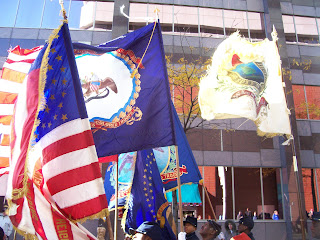


We’ll now shift our focus to the review itself, which began at 9 a.m. on Saturday November 6th. The parade had well over 100 USCT re-enactors, in addition to local high school marching bands, descendants of black Pennsylvanians who served in units, and the “100 Voices” – 100 young men who each represented one of Pennsylvania’s black soldiers.
The parade route had several stops where dignitaries and speakers would address the crowd and where local choral groups would sing Civil War era songs. Since it was a brisk day, whenever the parade would stop all of the recreated battle flags would continue snapping in the wind which created a beautiful effect which reminded me of the opening sequence of Gods & Generals. It was a stirring site to see so many USCT re-enactors marching in unison and I left Harrisburg very impressed with the way that the events had been organized and with the distinct impression that Harrisburg had just set the tone for Sesquicentennial Commemoration. Kudos to everyone involved with the Grand Review weekend and I am eagerly anticipating more great programs over the next four years.


Subscribe to:
Posts (Atom)