Wednesday, May 22, 2013

The World Turned Upside Down: The Bureau of Colored Troops Established 150 Years Ago Today

A lot can happen in two years.

In 2011, we saw the tragedy in Tucson, a royal wedding, the death of Usama bin Laden, and the official end of the Iraq War. In the ensuing two years we have seen more tragic shootings, another terrorist attack on American soil, and we are watching several scandals unfold that are rocking the administration that was on top of the world after the impressive feat of taking out the world’s most infamous terrorist and ending a controversial war that had cost much blood and treasure.

Yes, a lot can happen in two years.

As we look back at the tumult of the American Civil War, we can see a far more revolutionary transformation that took place over a two-year span.

For the nation that went to war for union in 1861, turning down all offers of African American enlistment and vowing that slavery was not the main bone of contention, underwent a dramatic upheaval that led to emancipation and the event that we commemorate today – the creation of the Bureau of Colored Troops.

Established by General Orders No. 143, the bureau gave former slaves the opportunity to strike a blow for their own freedom. It gave free blacks the opportunity to display their manhood and prove that they were worthy of receiving the full benefits of citizenship. And it allowed white enlisted men the occasion to advance themselves by attending military schools that would make them officers if they could pass the rigorous examination.

Looking back on this chain of events, students of the Civil War can see the inevitability of such a transformation. But for those who lived through it, the world had been turned upside down.

After May 22, 1863, African American soldiers and the officers that led them formed the tip of the spear in the Northern effort to bring about the new birth of freedom by force.

They had moved from the periphery of the war to the very core of it – let us hope the same is true for the remaining months of the sesquicentennial commemoration.




Sunday, May 19, 2013

Don Troiani’s New Market Heights Painting to be Unveiled June 24th

Greetings, everyone!

I apologize for the dearth of substantive posts lately, but I have been hard at work on an essay regarding that other conflict that I tend to write about (see here) for a publication edited by Edward G. Lengel that is set to come out in the next 6 months or so.

That being said, I received a very exciting e-mail last evening from Jim Paradis that had the invitation pictured below attached to it, and I wanted to help spread the word.

It seems that Don Troiani’s painting depicting the 6th USCT at New Market Heights is finally going to be unveiled at the Union League of Philadelphia on Monday June 24th! As some of you know, I helped Don with some of the painting’s details and wrote the historical fact sheet that will accompany the print.

The work is entitled “Three Medals of Honor” and it illustrates the moment when Lt. Nathan Edgerton, and Sgts. Thomas Hawkins and Alexander Kelly all risked life and limb to rescue the national and regimental colors of the 6th during the last gasps of Duncan’s assault in the early morning hours of September 29, 1864.

Don was kind enough to e-mail me a picture of the painting, and it is truly stunning, capturing all of the chaos, horror, sorrow, determination, and bravery that was all too common at New Market Heights.

It was an honor to be a part of this process and I know that all of you will agree with my assessment of the painting when it is unveiled next month!


Thursday, May 16, 2013

PRESS RELEASE: Richmond National Battlefield Commemorates Memorial Day at Ft. Harrison National Cemetery

Fort Harrison National Cemetery
RICHMOND, Va. - Richmond National Battlefield Park, in cooperation with the Department of Veterans Affairs, is sponsoring a Memorial Day program and wreath-laying to honor and remember those who have died in our nation’s service—especially those soldiers and sailors from the Civil War. This annual event is scheduled for Monday, May 27, at 12:00 p.m., at the Fort Harrison National Cemetery, on the Fort Harrison battlefield. The cemetery is located at 8620 Varina Road, two miles south of Route 5 and eight miles south of Richmond. More than 800 Civil War soldiers are buried at the Fort Harrison National Cemetery.

Jimmy Price, presently an adjunct professor of Civil War History at Germanna Community College, will speak at the cemetery. His talk is a part of the national park’s continuing commemoration of the sesquicentennial of the Civil War in the Richmond area. Mr. Price is well known for his recent book The Battle of New Market Heights: Freedom Will Be Theirs by the Sword, which is the only full-length book on that Henrico County battle. He also maintains a weblog entitled: “The Sable Arm: A Blog Dedicated to the United States Colored Troops of the Civil War Era.”

The public is invited to attend this free event.

Richmond National Battlefield Park protects 13 Civil War sites around the city of Richmond, Virginia. Experiencing the park’s battlefield sites and visitor centers usually takes a full day. A driving tour of the battlefields is available at any of the park’s sites. The main park visitor center is located at Historic Tredegar (470 Tredegar Street in Richmond) and provides museum exhibits, audio-visual programs and orientation services to help plan a visit to the battlefields.

For additional information, contact Richmond National Battlefield Park at 804-226-1981, or via the internet at www.nps.gov/rich or www.Facebook.com/RichmondNPS.

Wednesday, May 1, 2013

“What Will the Country Say?”


 Do those who argue that perhaps the war was unnecessary deserve the usual accusation that they are insufficiently alert to the moral evil of slavery? Could the wicked institution of slavery have been destroyed without the carnage of war? Did the differences in…social institutions make necessary the deaths of more than 600,000 Americans and the suffering of millions of others? – Elbert B. Smith, 1967

A nameless Confederate, killed May 3, 1863.

It has become a cliché in the study of the American Civil War to use well-worn phrases like William Tecumseh Sherman’s adage that “war is all hell” to convey the sheer magnitude of the slaughter that took place from 1861-1865. But if one looks at today’s popular historical art, the pre-eminent focus on battles in Civil War literature, and the bloodless re-enactments that have marked the commemoration of the sesquicentennial thus far, it would not be unreasonable to wonder – have we come to terms with the unspeakable horror that tainted the hallowed fields of Antietam or Gettysburg? Can we wrap our brains around the deaths of approximately 700,000 Americans and still attend anniversary events with the same sense of excitement?

Can we remember the Civil War as it really was, and not as we wish it could have been?

To put it differently, are we haunted or angered by Elbert Smith’s piercing question? Do we feel its weight, or roll our eyes and skip ahead to the morass of tactical details surrounding our “favorite” battle?

To bring this question down to reality, let us consider the Battle of Chancellorsville, which began in earnest 150 years ago today.

The clash around Chancellorsville is a tale often painted in bold and dashing colors – the rascally braggart Hooker, with his impeccable battle plan that seemed near perfect until he lost faith in himself; the mad genius Stonewall Jackson, in a role he was predestined for, leading the way in an attack that would have been condemned as sheer folly had it failed; and the gambling knight of old, Robert E. Lee, who laughed at the odds stacked against him and pulled off what many claim was his signature victory.

Civil War buffs are very familiar with this well-trodden ground, and the film Gods & Generals helped to popularize this version of events.

What many people don’t realize is that the worst fighting of the battle took place the day after Jackson was knocked out of the fight, at a place called Fairview where a man fell killed or wounded every three seconds. Indeed, May 3, 1863 ranks as the second bloodiest day of the entire Civil War.

Chancellorsville was a battle that contained high drama, reckless courage, amazing feats of heroism – and it was almost completely devoid of any real consequences, other than the horrific number of losses.

In all, there were 30,764 combined casualties.

Robert E. Lee himself wrote after the battle that, “Our people were wild with delight – I, on the contrary, was more depressed than after Fredericksburg; our loss was severe, and again we had gained not an inch of ground and the enemy could not be pursued.”

Lincoln could only hold his face in his hands and moan, "My God! My God! What will the country say?”

It is not my intent to belittle the commemoration taking place this weekend, or go off on a lark about the futility of the American Civil War, or warfare in general. Far from it.

But I definitely think that we need to wrestle more with these issues.

Preserving the Union and Emancipation were both unquestionably worthy causes to fight for.

All I ask is that we count the cost. 

Tuesday, April 9, 2013

Arlington USCT Commemoration: Cancelled

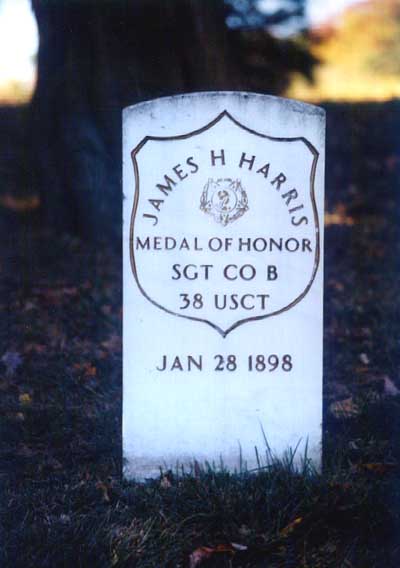
James H. Harris, Section 27, Arlington National Cemetery
Over the past few months I’ve made a few references to a program that was to be held at Arlington House: The Robert E. Lee Memorial on May 18th that would commemorate General Orders No. 143, which established the Bureau of Colored Troops.

Today, I learned that the powers that be have decided to cancel the event.

The reason?

Well, your guess is as good as mine.

The great bugaboo of the sequester cannot be given as the reason, since the event required no extra staffing costs and the re-enactment unit that had agreed to participate was coming for free.

So if you were in the mood to participate in a wreath-laying ceremony at a USCT grave, hear a rousing recruiting speech by a Frederick Douglass impersonator, or watch an infantry demonstration by a USCT re-enacting unit, well…

Maybe you should attend one of these events.

This is a troubling decision made by a site that already has a “conflict of interpretation.”

Wednesday, April 3, 2013

And Who Says All Civil War Re-enactors are Wackos?

Some of you may recall a post that I wrote two years ago defending Civil War re-enactors from the fiery darts of aspersion cast by Dr. Glenn W. Lafantasie in a Salon.com article that lambasted re-enactors as clueless morons who desecrate history and mislead the public.

Now, thanks to Conan O'brien, the good doctor may have had the last laugh.

Ah well.

Now, where did I put that peach pie...

Friday, March 29, 2013

Can We Honestly Say that the USCT Story is Still “Forgotten”?

Today I saw an advertisement for an upcoming Civil War event that is taking place in Richmond that features a living history program about USCTs. While it is always gratifying to see that such programs are taking place, the blurb advertising the event mentioned that it would honor “the conflict’s 200,000 unsung heroes.”

Something about that phrase bothered me, and the question that eventually formed in my head was – is it still fair to portray the story of African American Union soldiers using terms like “unsung,” “forgotten,” and “neglected”?

I would gander that such adjectives were appropriate during the 125th commemorations, but I’m not so sure that they are applicable in 2013. A random sampling of some reasons why I would say this would include:

1. A recent series of blog posts that dealt with the issue of historic sites interpreting the USCT story at places where USCT units did not even serve

2. USCT inclusion in popular Civil War art – something that was once reserved for showing every square foot of territory visited by Robert E. Lee, Stonewall Jackson, and Nathan Bedford Forrest during the war (indeed, the great Don Troiani has a print coming out in June that shows the 6th USCT at New Market Heights!)

3. New scholarship on previously overlooked people and battles
4. The fact that United States Colored Troops are front and center in Spielberg’s Lincoln
5. A museum and memorial in Washington DC solely dedicated to the history of US Colored Troops

6. Special events such as the USCT Grand Review in 2010 and the upcoming commemoration of General Orders No. 143 at Arlington National Cemetery on May 18th

Now, I’m in no way suggesting that we have exhausted the field – far from it. But I think we have achieved a level of general awareness of the contributions made by US Colored Troops to stop claiming that they have been relegated to the sidelines of Civil War history.

I don’t fault the event organizers for using such language – having been in the field of public history for 15 years, I certainly sympathize with the person who wrote the advertisement. You’re not going to draw a large crowd by using bland language that doesn’t “hook” the average person who could care less about history.

That being said, what do you think?

Would you still consider the saga of United States Colored Troops a “forgotten” aspect of Civil War history?

Friday, March 15, 2013

USCT Relics, Courtesy of the Old Virginia Blog

I always enjoy reading the thoughts and articles posted by Richard Williams over the Old Virginia Blog, and thought I’d pass along this most recent post about the discovery of some USCT relics.

I’m still fervently hoping to find cool stuff like this in my back yard, but…

Saturday, March 9, 2013

Moral Judgments and USCTs

The Battle of Jenkins' Ferry as portrayed in Lincoln
In a recent post over at Civil War Memory, Kevin Levin asked a series of probing questions about the ways in which USCT history is interpreted at public sites.

Part of one question in particular piqued my interest – “have we inadvertently made the message visitors receive [about US Colored Troops] too celebratory?”

This is something I have struggled with, especially when it comes to battlefield atrocities and the refusal by some USCT units to take prisoners.
One cannot approach the topic of US Colored Troops without encountering numerous occasions in which black soldiers were ruthlessly cut down on the battlefield while in the act of surrender. Olustee, Fort Pillow, the Crater, Saltville – the list of places where Confederate troops perpetrated these war crimes goes on and on.

But there is a flip side to this coin, and the way it is presented in the grand narrative can be problematic. Just as one can find numerous examples in Civil War texts that lay out the atrocities committed by rebel soldiers, one can also find the examples of when US Colored Troops went into action shouting “Remember Fort Pillow!” and encouraging their fellow soldiers to “raise the black flag” and give no quarter to any Confederate soldier who sought any.
Take, for example, an incident made popular in the opening scenes of Spielberg’s Lincoln – the clash at Jenkins’ Ferry.

Here is how the scene plays out in Tony Kushner’s script:
There’s no discipline or strategy, nothing depersonalized: it’s mayhem and each side intensely hates the other. Both have resolved to take no prisoners.
HAROLD GREEN (V.O.)
“Some of us was in the Second Kansas Colored. We fought the rebs at Jenkins’ Ferry last April, just after they’d killed every Negro soldier they captured at Poison Springs….So at Jenkins’ Ferry, we decided warn’t taking no reb prisoners. And we didn’t leave a one of ‘em alive. The ones of us that didn’t die that day, we joined up with the 116th U.S. Colored, sir. From Camp Nelson Kentucky.”
Private Green coolly relates the story of this atrocity without batting an eye, and Lincoln gives no obvious sign of disapproval for what he would know to be a violation of the articles of war. Thus, the audience is lulled into thinking that the action of Green and his compatriots was perfectly acceptable.

The fight at Jenkins’ Ferry (April 30, 1864) was retaliation for the Battle of Poison Spring (April 18, 1864) and was every bit as cold and ruthless as it appears on screen.

But one is inevitably left asking the question – if it was wrong for Confederates to show no mercy to surrendering black troops, what made it acceptable for USCTs to engage in the same activity?
Indeed, the Union soldiers who witnessed Jenkins’ Ferry wrestled with this question themselves. One white northerner wrote after the battle: “It looks hard, but the rebs cannot blame the negroes when they are guilty of the same trick.” Another simply observed, “It would not surprise me in the least if the war would ultimately be one of extermination. Its tendencies are in that direction now.” (Note: for a great treatment of Poison Springs and Jenkins’ Ferry, see Gregory J. Urwin, “’We Cannot Treat Negroes…as Prisoners of War’: Racial Atrocities and Reprisals in Civil War Arkansas” in The Price of Freedom: Slavery and the Civil War, Vol. 1).

Since the cause that the USCTs were fighting for is so much more compatible to 21st Century America’s views on justice and freedom, it seems as if these incidents have flown under the radar and are taken at face value as the Confederacy’s just deserts for fighting to establish a slaveholding republic in the first place. Indeed, that very well may be the case.
But what if it isn’t?

Even George Burkhart in his work Confederate Rage, Yankee Wrath: No Quarter in the Civil War writes that if the black Union soldiers and their commanding officers had ever been court martialed for killing soldiers in the act of surrender, they “would have packed many courtrooms. They killed a large but unknown number of wounded, surrendered, or captured Confederates. Though their lawyers might contend that the defendants only gave as good as they got, that argument would not have saved them” (p. 247).
As we continue into the Sesquicentennial and the topic of emancipation and black military service takes center stage, we would do well to wrestle with such vexing questions. The struggle is worthwhile.