 |
| The Beast |

Thursday, June 27, 2013


Monday, June 24, 2013
The Sesquicentennial and (Very) Current Perceptions of the Civil War
Is it me, or has the sesquicentennial been hit with some
negative waves lately?
 |
| At the end of the day, is this all we're left with? |
Last week I had a discussion with a co-worker who expressed
great surprise after listening to Town Talk with Ted Schubel interview John
Hennessy. What amazed this person was that Fredericksburg & Spotsylvania
National Military Park has not noticed an uptick in visitation to their
battlefields due to the sesquicentennial. As anyone who was at Chancellorsville
last month can attest, special events draw large crowds and generally do well,
but the amount of foot traffic through the door on any given Monday has not
noticeably increased.
A few days after this discussion, Tony Horwitz’s
Atlantic piece “150 Years of Misunderstanding the Civil War” lit up the blogosphere with different folks
parsing the notion of the Civil War as a “good war.”
Horwitz observes:
Looking backwards, and hitting the pause button at the Gettysburg Address or the passage of the 13th amendment, we see a "good" and successful war for freedom. If we focus instead on the run-up to war, when Lincoln pledged to not interfere with slavery in the South, or pan out to include the 1870s, when the nation abandoned Reconstruction, the story of the Civil War isn't quite so uplifting.
It is interesting to note that this discussion is taking
place alongside the new release of a popular history of what caused the war
and a major motion picture – both of which portray the Civil War as a tragic
and unjust affair.
Thomas Fleming’s A Disease in the Public Mind: A New Understanding of Why We Fought the Civil War claims:
Northern hatred for Southerners long predated their objections to slavery. They were convinced that New England, whose spokesmen had begun the American Revolution, should have been the leader of the new nation. Instead, they had been displaced by Southern “slavocrats” like Thomas Jefferson. This malevolent envy exacerbated the South’s greatest fear: a race war. Jefferson’s cry, “We are truly to be pitied,” summed up their dread. For decades, extremists in both regions flung insults and threats, creating intractable enmities. By 1861, only a civil war that would kill a million men could save the Union.
Civil War buffs looking for “warm and fuzzies” should
studiously avoid this one.
Also, this Friday Ron Maxwell’s Copperhead hits theaters. The plot description given on the film’s
website says in part:
It is a film of the war at home – of a family ripped apart by war, of fathers set against sons and daughters, of a community driven to an appalling act of vengeance against a man who insists on exercising his right to free speech during wartime. A story of the violent passions and burning feuds that set ablaze the home front during the Civil War, Copperhead the Movie is also a timeless and deeply moving examination of the price of dissent, the place of the individual amidst the hysteria of wartime, and the terrible price of war – a cost measured not in dollars but in fractured families, broken loves, and men dead before their time.
Again, not much to feel good about there.
Please don’t hear me saying that new books and movies should give us something to feel good
about (Stonewall Jackson got it right when he told
Jed Hotchkiss that “War is the greatest of evils.”)
But I wonder if this might be effecting the commemoration.
Could
it be that people will not join in commemorating something if they think it is
was unpleasant in the first place?
Time will tell.
Thursday, June 20, 2013
What do Elizabeth Keckley, William Whedbee Kirkland, and Gypsy Rose Lee Have in Common?
 |
| William Alexander Kirkland |
At the tail end of last year I wrote a series of posts that
chronicled the enigmatic life of Elizabeth Keckley’s son George W. D. Kirkland (see here and here).
As you’ll recall, when Ms. Keckley was a young woman she was relocated from
Virginia to Hillsborough, NC where her owner “married” her to his neighbor Alexander
McKenzie Kirkland.
Kirkland, a first generation American, belonged to a
prominent Hillsborough family and was a graduate of Norwich University, class
of 1828. He had made his money in the merchant trade, and used Keckley as a
concubine. In her words, Kirkland “persecuted” her for four years, and the
entire experience was “fraught with pain.” This abusive relationship resulted
in a son being born, whom the father named George. This is the same George W.
D. Kirkland whose life and service I wrote of earlier.
Alexander Kirkland died of cancer on May 4, 1843 when George
W. D. Kirkland was only 18 months old, but as I learned in the course of my
research, George was not the only son of Alexander Kirkland who would serve in
the Civil War. Kirkland had a wife named Anna McKenzie Cameron, and this union
also produced children.
 |
| Ayr Mount |
Enter William “Red Bill” Kirkland, Rear Admiral, USN.
William Alexander Kirkland was born at Ayr Mount, the ancestral
home of the Kirkland family, on July 3, 1836. He was the oldest of two boys who
were the legitimate sons of Alexander Kirkland. His cousin, William Whedbee
Kirkland, would rise to fame as the commander of one of the best brigades in
the Army of Northern Virginia (the Pettigrew – Kirkland - MacRae Brigade).
It is likely
that he never laid eyes on George Kirkland and, if he did, he probably would
not have known the child to be his half-brother. When he was 14, Kirkland was appointed from North
Carolina to attend the United States Naval Academy. After becoming a passed midshipman, he served on five different ships
attached to the Brazil Squadron from 1856 -1863.
Life at sea, far away from the troubles that were brewing in
his home state, must have squelched any desire to resign his commission and
join the Confederate Navy. Kirkland did not even return to the US until 1864,
when he received the command of the U.S.S. Owasco,
part of David G. Farragut's Western Gulf Blockading Squadron. Kirkland later commanded
the U.S.S. Winnebago, which was
involved in the fighting around Mobile Bay during the last days of the war.
 |
| USS Winnebago |
The Sixth Edition of The
Records of Living Officers of the U. S. Navy and Marine Corps (1898) chronicles
the rest of his illustrious career:
Commanding steamer “Wasp," South Atlantic Squadron, 1866-70. Commissioned as Commander, 1869 ; commanding store-ship "Guard," special service, 1873; ordinance duty, 1874; commanding "Wasp," and South Atlantic Station, 1875-6; commanding "Frolic" (fourth-rate). South Atlantic Station, 1876-7; commanding "Supply" (fourth rate), special service, 1878; leave of absence, 1879-80; commanding "Shenandoah," South Atlantic Station, 1881-2. Promoted to Captain, April, 1880; Navy Yard, Norfolk, 1883 ; commanding receiving-ship "Colorado," 1883-4; Navy Yard, New York, 1885-6 (from October, ]884, to January, 1885, in command) ; commanding receiving-ship "Vermont," 1887-9; Supervisor of Harbor, New York, from October, 1889, to July, 1891 ; commandant Navy Yard, League Island, July, 1891. Commissioned Commodore, June 27, 1893. Commissioned Rear-Admiral, March 1, 1895.
In 1894, Kirkland was removed from the command of the South
Atlantic Squadron after making controversial remarks related to American
missionaries in Syria. From 1896 until his death on August 12, 1898, Kirkland
commanded the Mare Island Navy Yard. He is buried in the Naval Academy Cemetery
at Annapolis.
While William Kirkland’s connection to George W. D. Kirkland
will no doubt fascinate Civil War buffs, fans of classic cinema will no doubt be
interested to learn that Kirkland’s grandson was Hollywood actor Alexander
Kirkland, who starred in such films as Black
Beauty (1933) and Strange Interlude
with Clark Gable. Alexander Kirkland
also had the distinction of being briefly married to Hollywood heart throb
Gypsy Rose Lee.
 |
| Gypsy Rose Lee |
As I have found to be the case over and over again with the
Kirkland family, truth is stranger than fiction.
Wednesday, June 19, 2013
“Three Medals of Honor” by Don Troiani
Well, the Philadelphia Inquirer has finally given the world a glimpse of Don Troiani’s painting “Three Medals of Honor” which depicts the 6th
USCT at New Market Heights.
Rather than go on at length about the painting
itself, have a look for yourself.
 |
| Courtesy of The Philadelphia Inquirer |
Here is a portion of the fact sheet that I wrote that will
accompany the print once it’s for sale:
At first, the advance went well – the morning mist enshrouded the attacking column and enveloped them “like a mantle of death” as their brigade commander recalled. Soon enough, however, the Confederate pickets were alerted and the concentrated rifle and artillery fire of veteran southern troops devastated the soldiers who had become entangled in the obstacles that the defenders had left in their path. As was the case in innumerable fights throughout the entire Civil War, the color guard was especially hard hit. The 6th USCT carried into battle that day the national colors and a blue regimental flag that was given to them in Pennsylvania bearing the motto, “Freedom for All.” Both flags, and the men who proudly carried them into the fight, went down within minutes. Seeing the desperate situation from different vantage points, three men saw the plight of the color guard and pushed forward to help. Risking life and limb for the honor of their unit, Lt. Nathan Edgerton, Sgt. Maj. Thomas R. Hawkins, and Sergeant Alexander Kelly slogged their way to the colors as best they could
The painting shows the moment when Edgerton and Hawkins arrived to bear away the regimental flag. Edgerton had recovered the flag from the dead body of another white officer and picked it up only to notice that he could not move freely. As he recalled after the battle, he looked down to see that “my hand was covered in blood, and perfectly powerless, and the flag staff [was] lying in two pieces.” Sgt. Maj. Hawkins, who had already distinguished himself as a natural leader of men, came to Edgerton’s assistance and helped carry the colors off, receiving serious wounds in the arm, hip, and foot. Coming to the rescue of the national colors was First Sergeant Alexander Kelly. He recalled that “after the color guard was all either killed or wounded …we got orders to retire.” Kelly weighed the risk and “seeing the flag was being left I seized them and carried them to rear where I rallied the few remaining men.”
I’m hopelessly biased on this matter, but I think it’s safe
to say that this is now the standard by which all other artwork depicting USCTs
in combat will be judged.
It was a huge honor to be a small part of the process of creating
this masterwork. It is a fitting tribute to the brave souls who fought in the
USCT.
Wednesday, May 22, 2013
The World Turned Upside Down: The Bureau of Colored Troops Established 150 Years Ago Today
A lot can happen in two years.
In 2011, we saw the tragedy in Tucson, a royal wedding, the death of Usama bin Laden, and the official end of the Iraq War. In the ensuing two years we have seen more tragic shootings, another terrorist attack on American soil, and we are watching several scandals unfold that are rocking the administration that was on top of the world after the impressive feat of taking out the world’s most infamous terrorist and ending a controversial war that had cost much blood and treasure.
Yes, a lot can happen in two years.
As we look back at the tumult of the American Civil War, we can see a far more revolutionary transformation that took place over a two-year span.
For the nation that went to war for union in 1861, turning down all offers of African American enlistment and vowing that slavery was not the main bone of contention, underwent a dramatic upheaval that led to emancipation and the event that we commemorate today – the creation of the Bureau of Colored Troops.
Established by General Orders No. 143, the bureau gave former slaves the opportunity to strike a blow for their own freedom. It gave free blacks the opportunity to display their manhood and prove that they were worthy of receiving the full benefits of citizenship. And it allowed white enlisted men the occasion to advance themselves by attending military schools that would make them officers if they could pass the rigorous examination.
Looking back on this chain of events, students of the Civil War can see the inevitability of such a transformation. But for those who lived through it, the world had been turned upside down.
After May 22, 1863, African American soldiers and the officers that led them formed the tip of the spear in the Northern effort to bring about the new birth of freedom by force.
They had moved from the periphery of the war to the very core of it – let us hope the same is true for the remaining months of the sesquicentennial commemoration.

In 2011, we saw the tragedy in Tucson, a royal wedding, the death of Usama bin Laden, and the official end of the Iraq War. In the ensuing two years we have seen more tragic shootings, another terrorist attack on American soil, and we are watching several scandals unfold that are rocking the administration that was on top of the world after the impressive feat of taking out the world’s most infamous terrorist and ending a controversial war that had cost much blood and treasure.
Yes, a lot can happen in two years.
As we look back at the tumult of the American Civil War, we can see a far more revolutionary transformation that took place over a two-year span.
For the nation that went to war for union in 1861, turning down all offers of African American enlistment and vowing that slavery was not the main bone of contention, underwent a dramatic upheaval that led to emancipation and the event that we commemorate today – the creation of the Bureau of Colored Troops.
Established by General Orders No. 143, the bureau gave former slaves the opportunity to strike a blow for their own freedom. It gave free blacks the opportunity to display their manhood and prove that they were worthy of receiving the full benefits of citizenship. And it allowed white enlisted men the occasion to advance themselves by attending military schools that would make them officers if they could pass the rigorous examination.
Looking back on this chain of events, students of the Civil War can see the inevitability of such a transformation. But for those who lived through it, the world had been turned upside down.
After May 22, 1863, African American soldiers and the officers that led them formed the tip of the spear in the Northern effort to bring about the new birth of freedom by force.
They had moved from the periphery of the war to the very core of it – let us hope the same is true for the remaining months of the sesquicentennial commemoration.

Sunday, May 19, 2013
Don Troiani’s New Market Heights Painting to be Unveiled June 24th
Greetings, everyone!
It was an honor to be a part of this process and
I know that all of you will agree with my assessment of the painting when it is unveiled
next month!

I apologize for the dearth of substantive posts lately, but
I have been hard at work on an essay regarding that other conflict that I tend
to write about (see here) for a publication edited by Edward G. Lengel that is
set to come out in the next 6 months or so.
That being said, I received a very exciting e-mail last
evening from Jim Paradis that had the invitation pictured below attached to it,
and I wanted to help spread the word.
It seems that Don Troiani’s painting depicting the 6th
USCT at New Market Heights is finally going to be unveiled at the Union League of Philadelphia on Monday June 24th! As some of you know, I helped Don with
some of the painting’s details and wrote the historical fact sheet that will
accompany the print.
The work is entitled “Three Medals of Honor” and it illustrates
the moment when Lt. Nathan Edgerton, and Sgts. Thomas Hawkins and Alexander
Kelly all risked life and limb to rescue the national and regimental colors of
the 6th during the last gasps of Duncan’s assault in the early morning hours of
September 29, 1864.
Don was kind enough to e-mail me a picture of the painting,
and it is truly stunning, capturing all of the chaos, horror, sorrow,
determination, and bravery that was all too common at New Market Heights.

Thursday, May 16, 2013
PRESS RELEASE: Richmond National Battlefield Commemorates Memorial Day at Ft. Harrison National Cemetery
 |
| Fort Harrison National Cemetery |
Jimmy Price, presently an adjunct professor of Civil War History at Germanna Community College, will speak at the cemetery. His talk is a part of the national park’s continuing commemoration of the sesquicentennial of the Civil War in the Richmond area. Mr. Price is well known for his recent book The Battle of New Market Heights: Freedom Will Be Theirs by the Sword, which is the only full-length book on that Henrico County battle. He also maintains a weblog entitled: “The Sable Arm: A Blog Dedicated to the United States Colored Troops of the Civil War Era.”
The public is invited to attend this free event.
Richmond National Battlefield Park protects 13 Civil War sites around the city of Richmond, Virginia. Experiencing the park’s battlefield sites and visitor centers usually takes a full day. A driving tour of the battlefields is available at any of the park’s sites. The main park visitor center is located at Historic Tredegar (470 Tredegar Street in Richmond) and provides museum exhibits, audio-visual programs and orientation services to help plan a visit to the battlefields.
For additional information, contact Richmond National Battlefield Park at 804-226-1981, or via the internet at www.nps.gov/rich or www.Facebook.com/RichmondNPS.
Tuesday, May 7, 2013
Wednesday, May 1, 2013
“What Will the Country Say?”
Do those who argue
that perhaps the war was unnecessary deserve the usual accusation that they are
insufficiently alert to the moral evil of slavery? Could the wicked institution
of slavery have been destroyed without the carnage of war? Did the differences
in…social institutions make necessary the deaths of more than 600,000 Americans
and the suffering of millions of others? – Elbert B. Smith, 1967
 |
| A nameless Confederate, killed May 3, 1863. |
It has become a cliché in the study of the American Civil
War to use well-worn phrases like William Tecumseh Sherman’s adage that “war is
all hell” to convey the sheer magnitude of the slaughter that took place from
1861-1865. But if one looks at today’s popular historical art, the pre-eminent focus
on battles in Civil War literature, and the bloodless re-enactments that have
marked the commemoration of the sesquicentennial thus far, it would not be
unreasonable to wonder – have we come to terms with the unspeakable horror that
tainted the hallowed fields of Antietam or Gettysburg? Can we wrap our brains
around the deaths of approximately 700,000 Americans and still attend
anniversary events with the same sense of excitement?
Can we remember the Civil War as it really was, and not as
we wish it could have been?
To put it differently, are we haunted or angered by Elbert
Smith’s piercing question? Do we feel its weight, or roll our eyes and skip ahead to the morass of tactical details surrounding our “favorite” battle?
To bring this question down to reality, let us consider the
Battle of Chancellorsville, which began in earnest 150 years ago today.
The clash around Chancellorsville is a tale often painted in
bold and dashing colors – the rascally braggart Hooker, with his impeccable
battle plan that seemed near perfect until he lost faith in himself; the mad
genius Stonewall Jackson, in a role he was predestined for, leading the way in
an attack that would have been condemned as sheer folly had it failed; and the gambling
knight of old, Robert E. Lee, who laughed at the odds stacked against him and
pulled off what many claim was his signature victory.
Civil War buffs are very familiar with this well-trodden
ground, and the film Gods & Generals
helped to popularize this version of events.
What many people don’t realize is that the worst fighting of
the battle took place the day after Jackson was knocked out of the fight, at a
place called Fairview where a man fell killed or wounded every three seconds. Indeed, May 3, 1863 ranks as the second bloodiest
day of the entire Civil War.
Chancellorsville was a battle that contained high drama, reckless
courage, amazing feats of heroism – and it was almost completely devoid of any
real consequences, other than the horrific number of losses.
In all, there were 30,764 combined casualties.
Robert E. Lee himself wrote after the battle that, “Our
people were wild with delight – I, on the contrary, was more depressed than
after Fredericksburg; our loss was severe, and again we had gained not an inch
of ground and the enemy could not be pursued.”
Lincoln could only hold his face in his hands and moan, "My
God! My God! What will the country say?”
It is not my intent to belittle the commemoration taking
place this weekend, or go off on a lark about the futility of the American
Civil War, or warfare in general. Far from it.
But I definitely think that we need to wrestle more with
these issues.
Preserving the Union and Emancipation were both unquestionably
worthy causes to fight for.
All I ask is that we count the cost.
Tuesday, April 9, 2013
Arlington USCT Commemoration: Cancelled
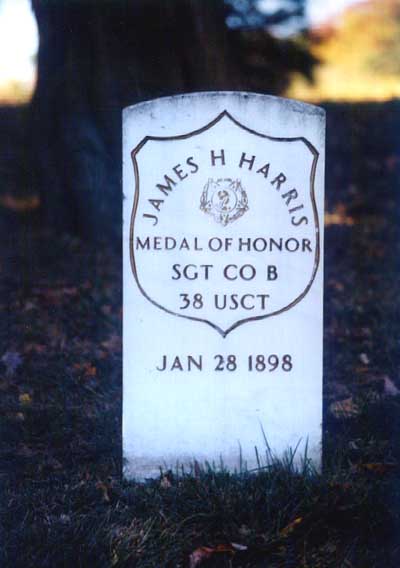 |
| James H. Harris, Section 27, Arlington National Cemetery |
Today, I learned that the powers that be have decided to cancel the event.
The reason?
Well, your guess is as good as mine.
The great bugaboo of the sequester cannot be given as the reason, since the event required no extra staffing costs and the re-enactment unit that had agreed to participate was coming for free.
So if you were in the mood to participate in a wreath-laying ceremony at a USCT grave, hear a rousing recruiting speech by a Frederick Douglass impersonator, or watch an infantry demonstration by a USCT re-enacting unit, well…
Maybe you should attend one of these events.
This is a troubling decision made by a site that already has a “conflict of interpretation.”
Subscribe to:
Posts (Atom)