Today I had the pleasure of reading Eric Wittenberg’s latest post over at his blog regarding what he considers the top 12 Civil War books of all time. Eric was inspired by Glen LaFantasie, who wrote his own top 12 list which you can find here. This, in turn, inspired me to put together my own list of what I think are the top 12 books about United States Colored Troops (although I should hasten to add that I am in no way putting myself in the same category as Wittenberg or LaFantasie). Since the literature pertaining to black soldiers is not as varied as Civil War literature in general, I will refrain from using the same constraints that both experts placed upon themselves in their selections.
I’m sure that some of you out there may disagree with my choices and, if that is the case, I’d love to hear your opinions as to which book you think should have made the list (but trust me – narrowing the selection to 12 was a very difficult process).
Now, without further ado, here is my top 12 list:
12. The Black Civil War Soldiers of Illinois: The Story of the Twenty-ninth U.S. Colored Infantry by Edward A. Miller, Jr. Published by the University of South Carolina Press in 1998, this is one of the finest and most complete regimental histories of any USCT unit yet written. Dr. Miller consulted pension records, regimental papers, reports, and letters to trace the history of the 29th USCI (the only USCT unit raised in Illinois) from its recruitment in late 1863 through its combat experience with the Army of the Potomac, where it served in the rear guard during the Overland Campaign and finally saw action in the infamous Battle of the Crater. Miller goes on to chronicle the 29th’s consolidation into the 25th Army Corps and its service in the Appomattox Campaign and postwar service in Texas. By examining the extant records and looking at the demographics of the men who served in the unit, Miller paints a nearly complete picture of a USCT regiment in camp and on the battlefield.
11. The Black Phalanx: A History of the Negro Soldiers of the United States in the Wars of 1775-1812, 1861-‘65 by Joseph T. Wilson. This remarkable work was written by a veteran of both the 2nd Louisiana Native Guard and the 54th Massachusetts, and was first published in 1887 (when it sold for a whopping $3.00). Part II of the book offered the first history of African American service during the Civil War, and Wilson did an admirable job of compiling as many contemporary sources as he could in this volume (which is all the more interesting considering he was living in Virginia when he wrote the book). Wilson detailed the pervasive prejudice against black troops, their heroism on the field of battle, atrocities committed by Confederate soldiers against USCTs, and even compiled a list of black Medal of Honor recipients. As is the case when anyone is writing on a subject for the first time, The Black Phalanx serves as a compilation of source material rather than a comprehensive analysis. That being said, it is still very much worth reading.
10. Campfires of Freedom: The Camp Life of Black Soldiers During the Civil War by Keith P. Wilson. This is hands down one of the most fascinating books I have read on the Civil War, let alone on African American soldiers. I’ve always been interested in the life of the common soldier, and Wilson’s work provides a detailed look at the camp life of black soldiers. The book offers a plethora of fascinating and little known facts (the 54th Massachusetts had a glee club?) and looks at training, discipline, the religious life of black soldiers and chaplains, and how the soldiers chose to spend their free time. Wilson – a native of Australia – says that the purpose of his book was to “describe the soldiers’ lives in their camps…bring into focus the emotional texture of military life, to describe the dreams, aspirations, ambitions, and desires of the common soldier…[and] to analyze the process of cultural change that occurred within the army camps” (p. xiii). The result is a fascinating work that any Civil War buff will want on their shelf.
9. After the Glory: The Struggles of Black Civil War Veterans by Donald R. Shaffer. This 2004 offering from the University Press of Kansas takes a look at what happened to black Union veterans after the cessation of hostilities. Shaffer's work is based on a random sample of the postwar experience of 1,000 ordinary black soldiers, a look at 200 African American veterans involved in "notable activities" after 1865, and a special census taken in 1890 of surviving black veterans. The result is a complex tapestry of mingled hope, achingly slow progress, and the ugly realities of post war racism. Required reading for a complete understanding of the USCT experience.
8. A Regiment of Slaves: The 4th United States Colored Infantry, 1863 –1866 by Edward G. Longacre. Perhaps this book made it onto my list because it details the history of a unit that won its laurels at New Market Heights (four Medals of Honor went to the men of the 4th) and included the inimitable Christian Fleetwood. That said, however, the 4th USCI is certainly a very worthy topic for a regimental history. Not only did the 4th rack up an impressive combat record, it is also noteworthy for its social make up. Organized in Baltimore in the summer of 1863, the 4th USCI consisted of free men such as Christian Fleetwood (who read Greek, Latin, French, and Spanish) and former slaves, which presented a recruiting problem in a loyal state that still maintained the institution of slavery. Still, the 4th participated in the opening battles around Petersburg, was held in reserve at the Crater, helped construct the Dutch Gap canal, and won fame on the fields of New Market Heights. The unit took part in the expedition against Fort Fisher before being mustered out in Washington in 1866 (where Company E posed for one of the most iconic images of United States Colored Troops ever taken). Longacre does an admirable job and proves that there is ample source material sufficient to chronicle USCT units if you do enough digging.
7. Army Life in a Black Regiment by Thomas Wentworth Higginson. Written by a militant abolitionist turned officer of the 1st South Carolina (later the 33rd USCT), this book was originally a series of essays that made it into book form in 1870. Higginson was hell bent on proving that former slaves could be turned into the equals of any white unit fielded by the Union army, and that military service was a key first step to black citizenship . The book has many high points such as Higginson’s account of reading the Emancipation Proclamation to his men and it contains eloquent observations such as his concluding sentence – “It was their demeanor under arms that shamed the nation into recognizing them as men.” While Higginson’s observations may seem outdated and his paternalistic attitude may grate against modern conceptions of race and equality, the reader should keep in mind that Higginson put himself at great risk during the war, since the Confederates would not have hesitated to make an example of an officer in command of black troops who hailed from Massachusetts and had fervently supported John Brown.
6. Freedom For Themselves: North Carolina’s Black Soldiers in the Civil War Era by Richard M. Reid. This 2008 work takes on the ambitious task of relating the history of four of the five African American units raised in North Carolina – the 35th, 36th, and 37th USCI and the 14th USCHA. Reid states that "the real value of this study lies in the fact that the activities, abilities, and utilization of these four regiments were sufficiently varied to encompass the experiences of most black soldiers" (326, 328). Mastering just about all of the primary source material on these four units, Reid not only gives a masterful account of their military service but he also delves into the realm of social history with a fascinating chapter that focuses on what happened to the service member’s families, especially those who sought shelter at the freedmen’s colony on Roanoke Island. Reid also examines what happened to these soldiers after the war during Reconstruction and reviews how veterans adjusted to life in a state that tragically fell under the control of former Confederates.
5. A Grand Army of Black Men: Letters From African American Soldiers in the Union Army, 1861-1865, edited by Edwin S. Redkey. Redkey’s 1992 compilation of 129 letters written to black and abolitionist newspapers forever put to rest Bell Wiley’s lament of a “dearth of letters written by the 200,000 blacks who donned the blue.” Redkey collected soldier letters written to the Christian Recorder, The Weekly Anglo-African, the Pine and Palm and other abolitionist newspapers from the period. Each chapter contains a substantial introduction and each letter or part of a letter is headed by a brief paragraph that gives essential information about the author and the events chronicled in the letter. The letters have a running theme of how African American soldiers saw soldiering as an opportunity to “elevate” their race and earn the rights and benefits of citizenship. They are often proud of their accomplishments, indignant at injustices that sprang from the Confederate army as well as their own, and confident of ultimate success. Noah Andre Trudeau mentions in the beginning of his chronicle of USCTs that Redkey’s book was a major influence upon his writing. The only down side to this otherwise marvelous collection is the unavoidable reality that letters written to newspaper editors were only written by the small portion of USCTs who could read and write. Furthermore, soldiers writing to their local newspapers tended to put a positive spin on their experiences and tell the readers what they already wanted to hear. Thus, there is a substantial portion of United States Colored Troops whose voices will remain forever silent.
4. Black Soldiers in Blue: African American Troops in the Civil War Era, edited by John David Smith. This wonderful collection of 14 essays includes selections from authorities such as William Glenn Robertson, Noah Andre Trudeau, the late Art Bergeron, John Cimprich, and Keith Wilson among others. Some of the essays are short battle histories of the fighting that took place at Port Hudson, Milliken’s Bend, Olustee, the Crater, New Market Heights, and Saltville. Other essays examine the lives of USCT chaplains, black recruitment efforts in the Mississippi Valley, USCTs who fought in Tennessee, and an outstanding survey of the fortunes of the United States Colored Cavalry. While each scholarly piece can stand on its own, the essays are in chronological order and if the book is read from cover to cover this work will serve as an outstanding overview of black Union soldiers.
3. Like Men of War: Black Troops in the Civil War, 1862-1865 by Noah Andre Trudeau. Coming in at number three is Noah Andre Trudeau’s now-classic 1998 fighting history of the USCT. Trudeau did an amazing amount of research, taking up where Redkey left off by delving deep into the extant collection of letters, diaries, and pension records left by black troops and their officers. The result is a vivid narrative that brims with firsthand accounts and should forever put to rest the misguided notion that African Americans were passive and scarcely lifted a finger to secure their own freedom (an idea touted by William E. Woodward in 1928 and one that is still popular in Neo-Confederate and Southern Heritage circles). Unfortunately this book never achieved the acclaim of some of Trudeau’s other works. Perhaps the Sesquicentennial will remedy that.
2. Forged in Battle: The Civil War Alliance of Black Soldiers and White Officers by Joseph T. Glatthaar. Joe Glatthaar had the good fortune of publishing his study on the relationship between black enlisted men and their white officers right on the heels of the motion picture Glory. That being said, it has landed in the number two slot for a reason – it is the most detailed analysis yet written on said relationship. Glatthaar dispels the notion that all white officers who led black troops were mini Thomas Wentworth Higginsons or Robert Gould Shaws. Many officers thought poorly of their men, held the same racist views that permeated American society at the time, and could be extremely harsh on their men for what most would consider minor infractions. Moreover, many white enlisted men only sought the opportunity to serve in the USCT because they desired higher rank and the resultant pay increase that came with it (Glatthaar quotes one Illinois soldier who quipped, “I would drill a company of alligators for a hundred and twenty [dollars] a month”). However, the process by which white men were recruited and tested shows that, no matter what their motivations, the USCT provided some of the best trained officers to emerge from the Union war effort. The book goes on to examine recruitment, training, dealing with the racism and opposition, and the test of battle that many of these men faced. The book ends with an examination of occupation duty and the postwar careers of some of the men who fought in the USCT. While Glatthaar clearly achieved his stated goal of examining “the inner workings of…black commands, to investigate conduct, attitudes, and experiences among the participants” (p. x), my main quibble is that he rarely mentions the Army of the James, which just happened to be the fighting force with the largest concentration of black soldiers in the entire Union army. Why he did not investigate this neglected army is beyond me, but the book is still one of the very best in its field.
1. The Sable Arm: Negro Troops in the Union Army, 1861-1865 by Dudley Taylor Cornish. It should come as no surprise that this book is still the standard introductory work on the subject of United States Colored Troops and that, even though it is 54 years old, it still has not been surpassed. When the book debuted in 1956, the struggle for civil rights was still raging and many of the popular titles on the Civil War made no mention of black troops whatsoever. Cornish’s assertion that “As a soldier in the Union army, the Negro soldier proved his manhood and established a strong claim to equality of treatment and opportunity” may have ruffled some feathers, but he provided the necessary data and statistical evidence to back up his claim. The book was well received in the scholarly community, and T. Harry Williams asserted that “The Sable Arm must be rated as a major study that throws new illumination on a neglected side of the war.” In the book, Cornish vividly describes the various forces and unique individuals who compelled the Lincoln Administration to adopt the controversial policy of recruiting free blacks and runaway slaves for military service, the formation of the 166 regiments that made up the United States Colored Troops , and the performance of those units in combat. Cornish set the bar very high and blazed a trail for those who devote themselves to the study of the African American contribution to Union victory. If you wish to deepen your understanding of the USCT, start by reading The Sable Arm. I promise you, you won’t regret it.

Tuesday, December 28, 2010


Monday, December 20, 2010
A Mighty Good Stocking Stuffer

The Virginia Sesquicentennial of the Civil War Commission is now offering their most recent signature conference, "Race, Slavery and the Civil War: The Tough Stuff of American History and Memory" on DVD.
Now I know what most of you out there are thinking – why would they release this on DVD when the conference was covered so comprehensively by this very blog? I mean, if it ain’t broke…
Joking aside, this two-disc set is out just in time for the holidays and would make a great stocking stuffer for that Civil War enthusiast in your family (assuming you were kind enough to invite him over this year – I know how annoying we can be). The Commission has done excellent work in promoting sound scholarship and has set the tone for how the Sesquicentennial should be commemorated throughout the nation. Compare their work with what’s happening in South Carolina today, and I think you’ll see what I mean.
For more information, visit the Commission’s home page here.
Wednesday, December 15, 2010
“The Question is Settled”

Today marks the 146th anniversary of the first day of the Battle of Nashville. While most students of the Civil War are aware of the overall importance of this final hurrah for John Bell Hood and his Army of Tennessee, some might be surprised to learn that United States Colored Troops played an important part in this decisive Union victory. Moreover, that any black troops were allowed to participate in this fight at all should not be taken lightly – Union commanders in the Western Theater (William Tecumseh Sherman being one of the most vociferous and influential among them) considered USCTs untrustworthy for front line service and tried to limit their service to nothing more than manual labor. When the fighting was over at Nashville, however, Maj. Gen. George Thomas was overheard to say, “Gentlemen, the question is settled; negroes will fight.”
The battle itself was fought on Thursday and Friday, December 15 & 16, 1864. Maj. Gen. George H. Thomas, commanding a Federal force of about 55,000 men, attacked and routed the Confederate army commanded by Gen. John B. Hood, which numbered fewer than 25,000. On December 2nd Hood had settled his army before Nashville, strongly entrenching what was left of his army along a series of hills south of the city. Since he didn’t have enough men to attack Thomas, Hood simply waited in his trenches for Thomas to attack him. Thomas obliged on the morning of December 15th.
The plan of attack called for the main assault to be directed against the Confederate left flank. A diversionary assault would be launched prior to the main effort, and it was in this diversion that many of the USCTs would “see the elephant” for the first time. They were commanded by a Pennsylvanian named Maj. Gen. James B. Steedman. Steedman’s subordinate, Colonel Thomas J. Morgan of the 1st Colored Brigade thought that all his men had to do that morning was clear out some lightly-manned Confederate rifle pits. As it turned out, Morgan was dead wrong. When his men attacked around 8 a.m. all was smooth sailing until they encountered a deep ravine near the cut of the Nashville & Chattanooga Railroad. At that point Confederate artillery and musket fire ripped into the ranks of the black troops from three different directions. One Confederate later recalled, “We had the negroes in our trap, and when we commenced firing on them, complete demoralization followed.” After several minutes of severe punishment, Morgan’s soldiers fell back to the Murfreesboro Pike, where they remained for the rest of the day. Even if the diversion itself had failed, the main effort against Hood was a resounding success and Thomas pursued Hood’s men until nightfall of the 15th.
Thomas was pressured to keep pressing Hood’s men, and thus launched follow-up assaults on December 16th. USCT units that had not participated in the first days fighting now had a chance to prove themselves. They went into the attack on the Confederate lines at Overton Hill, and once again they were raked with intense artillery fire (one survivor said that the air “seemed as full of the death-laden missiles as of hail in a driving hail storm”). Still, the black troops pressed on. The 13th USCT ignored the intense fire and advanced all the way up to the Confederate line. After one of the color-bearers was hit, a second one retrieved the flag until he was hit. Eventually five more men of the color guard stepped forward to rescue the colors one at a time – all would be shot down. One survivor later recalled, “The last color bearer shook the flag over the rebel works but it was snatched from his hand, and he was shot. Every one of the color-guard was either killed or wounded.” The 13th lost 40% of its strength in this assault. A Confederate who witnessed this attack said that he “never saw dead men thicker than” at Nashville.

Nevertheless, black soldiers knew that every time they performed well in battle that this would have far reaching consequences beyond the battlefield. Every victory was a small step in the long road to citizenship and social equality. One of those steps was taken 146 years ago today.
USCT Order of Battle
Provisional Detachment (District of the Etowah) MG James B. Steedman
Provisional Division, BG Charles Cruft
1st Colored Brigade Col Thomas J. Morgan
14th U.S. Colored Troops: Ltc Henry C. Corbin
16th U.S. Colored Troops: Col William B. Gaw
17th U.S. Colored Troops: Col William R. Shafter
18th U.S. Colored Troops (battalion): Maj Lewis D. Joy
44th U.S. Colored Troops: Col Lewis Johnson
2nd Colored Brigade, Col Charles R. Thompson
12th U S. Colored Troops: Ltc William R. Sellon, Cpt Henry Hegner
13th U.S. Colored Troops: Col John A. Hottenstein
100th U.S. Colored Troops: Maj Collin Ford
1st Battery, Kansas Light Artillery: Cpt Marcus D. Tenney
Post of Nashville, BG John F. Miller
Garrison Artillery, Maj John J. Ely
Battery A, 3rd U.S. Colored Light: Cpt Josiah V. Meigs
Saturday, December 11, 2010
A Grand Review Indeed, Part II
In the first installment of my review of the wonderful events surrounding the United Stated Colored Troops Grand Review Weekend in Harrisburg, PA last month, I covered the speakers and topics of the scholarly symposium that took place the day before the parade as well as the interesting experiences I had at a dinner for USCT descendants that night.
We’ll now shift our focus to the review itself, which began at 9 a.m. on Saturday November 6th. The parade had well over 100 USCT re-enactors, in addition to local high school marching bands, descendants of black Pennsylvanians who served in units, and the “100 Voices” – 100 young men who each represented one of Pennsylvania’s black soldiers.
The parade route had several stops where dignitaries and speakers would address the crowd and where local choral groups would sing Civil War era songs. Since it was a brisk day, whenever the parade would stop all of the recreated battle flags would continue snapping in the wind which created a beautiful effect which reminded me of the opening sequence of Gods & Generals. It was a stirring site to see so many USCT re-enactors marching in unison and I left Harrisburg very impressed with the way that the events had been organized and with the distinct impression that Harrisburg had just set the tone for Sesquicentennial Commemoration. Kudos to everyone involved with the Grand Review weekend and I am eagerly anticipating more great programs over the next four years.


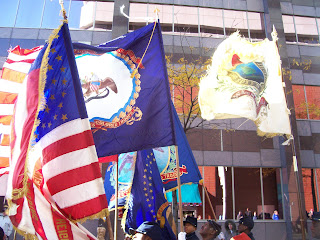


We’ll now shift our focus to the review itself, which began at 9 a.m. on Saturday November 6th. The parade had well over 100 USCT re-enactors, in addition to local high school marching bands, descendants of black Pennsylvanians who served in units, and the “100 Voices” – 100 young men who each represented one of Pennsylvania’s black soldiers.
The parade route had several stops where dignitaries and speakers would address the crowd and where local choral groups would sing Civil War era songs. Since it was a brisk day, whenever the parade would stop all of the recreated battle flags would continue snapping in the wind which created a beautiful effect which reminded me of the opening sequence of Gods & Generals. It was a stirring site to see so many USCT re-enactors marching in unison and I left Harrisburg very impressed with the way that the events had been organized and with the distinct impression that Harrisburg had just set the tone for Sesquicentennial Commemoration. Kudos to everyone involved with the Grand Review weekend and I am eagerly anticipating more great programs over the next four years.


Tuesday, November 30, 2010
Major General Ricky Bobby, Anyone?

I trust all of you had a great Thanksgiving weekend and properly gorged yourselves on turkey, stuffing, and football as is the tradition in this great nation of ours.
I apologize for taking a hiatus from blogging, but I’ve had my hands full with several exciting – and time consuming – projects as of late.
Truth be told, I hadn’t really been following what was happening in the Civil War blogosphere for about two weeks. Imagine my surprise, then, when I learned of an 8 part mini-series that is being produced in the style of Band of Brothers entitled To Appomattox. Like many of you out there, I thought that no producer in his right mind would touch the subject of the Civil War after the disaster that was Gods & Generals.
Well, I thought wrong.
While the series is still in its infancy, the website offers some insights into the type of product that we might reasonably expect.
One of the most…um, shall we say… interesting aspects is that the producers have teamed up with NASCAR and are hoping to feature several stock car racers in the film (one is already slated to play John Gordon). Dr. Simpson has done a fine job of commenting on this odd pairing over at Civil Warriors, so I’ll refer you to his blog and leave it at that.
Not only is NASCAR associated with this film, so are several country music stars, including Dwight Yokam, Laura Bundy, and Kix Brooks of the musical atrocity known as Brooks and Dunn.
Combine the NASCAR and country music connection and it would be easy to start stereotyping – but to be fair, both Yokam and Brooks are playing Yankees (and for those of you who think Dwight Yokam can’t act, I refer you to his performance in Sling Blade).
Also, there is legitimate acting talent in the film. Paul Giamatti, Will Patton, and Bill Paxton are certainly not b-list actors (although the choice of Giamatti as James Longstreet just might baffle me till the day I die - let us pray that his beard will not resemble the deceased wildebeest that was duct taped to Tom Berenger's face in Gettysburg ).
In any case, if you review the actors and who they are portraying you will quickly notice that the cast is lily white – not a single African American cast member is listed because there are no African American characters as of yet.
And that’s deeply troubling.
When you see that Robert E. Lee, Stonewall Jackson, James Longstreet, Albert Sidney Johnston, Joseph E. Johnston, Simon Bolivar Buckner (really?), and even Sallie Pickett are major characters in the film you’d think they could find room for, oh, say Frederick Douglass? Harriet Tubman? It’s not like these are lesser known figures in the history of the conflict – I’m not asking for Christian Fleetwood or Decatur Dorsey to make it into the film for crying out loud.
But so far there is no black presence in the film at all.
If we are treated to another depiction of loyal slaves and Stonewall Jackson as the “black man’s friend” like in Gods and Generals, then I fear that this could have a ripple effect for the forthcoming Sesquicentennial commemoration.
Like the tourists who flocked to Gettysburg to find out where Buster Kilrain was wounded after the movie Gettysburg was released, we might have families seeking out the emblems of the Lost Cause just because they saw a movie that had their favorite singer in it.
Then again, the producers might land some excellent African American actors who can help balance out the story and help viewers ponder the complexities of the war. You never know.
For now, I will hope that there is no underlying agenda to this film and remain cautiously optimistic that this mini-series will strive to place accuracy over mythology. I will hope that USCTs are not only given some role in the movie, but that they are portrayed accurately – not as ignorant objects of pity, but as competent fighting men who had the same capacity for cowardice and bravery as their white counterparts.
I will hope – but I won’t hold my breath.
Monday, November 15, 2010
Thursday, November 11, 2010

Tuesday, November 9, 2010
My Final Word on Bruce Levine & Black Confederates
For a blog that doesn’t normally receive that many comments to begin with, I’ve noticed an increase in the number of people anonymously commenting on my post that detailed Dr. Bruce Levine’s talk on Black Confederates at the Virginia Sesquicentennial Commission’s Signature Conference on Race and Slavery.
Apparently some folks think that my summary of Dr. Levine’s talk is in fact my own commentary on the topic.
I have decided not to address any of these comments because they tend to do what the Black Confederate debate in general does – draw attention away from those African Americans who DID serve in large numbers during the Civil War.
However, the good folks at the Virginia Sesquicentennial Commission have posted Dr. Levine’s talk on YouTube for all to see.
So watch, and enjoy all you anonymous Lost Causers out there.
But consider this the END of the debate, at least on this website.
This blog deals with ACTUAL black soldiers who can be documented by looking at ACTUAL government and military documents and whose names and occupations can be found on the muster rolls of the ACTUAL units that they served in.
If you want to cry foul and indignantly rant about the thousands upon thousands of blacks who donned the gray, I’m sure Kevin over at Civil War Memory would LOVE to speak with you (you’re welcome, Kevin).
We deal in facts here at The Sable Arm.
Monday, November 8, 2010
A Grand Review Indeed, Part I
Well, as most of you know I had the distinct pleasure of attending the festivities relating to the recent United States Colored Troops Grand Review Weekend in Harrisburg, PA.
I have to say, out of all of the events, lectures, and symposiums I’ve been to over the past few years, this one ranks right up there with the time I arranged to meet with the family of one of the New Market Heights Medal of Honor recipients. The three events I attended – the symposium “Rather Die Freemen than Live to be Slaves”, the White Carnation League Dinner, and the review itself – all exceeded the expectations I had when I decided at the last minute to make the trek up to my state of birth.
This first speaker was Dr. James Horton, professor emeritus at George Washington University who spoke on the topic of “Slavery: The Great American Contradiction”. Much of this material was similar to what Dr. Horton spoke about at the Virginia Sesquicentennial Committee’s Signature Conference on Race and Slavery back in September. At the conclusion of his talk Dr. Horton mentioned that he is in the process of editing the diary of a soldier who served in the 8th USCT, which should be an incredible read to say the least. He also mentioned some fascinating research he is conducting on soldiers from what is now Hawaii who served in the Union army.
The next speaker was Hari Jones, who serves as the Assistant Director and Curator for the African American Civil War Museum & Memorial in Washington D.C. If you’ve never heard Hari speak before, do yourself a favor and find out where he’s speaking next and go see him. You will not regret it. His riveting presentation entitled “The USCT and Pennsylvania” traced the origins and history of all of the USCT units raised in that great state (the 3rd, 6th, 8th, 22nd, 24th, 25th, 32nd, 41st, 43rd, 45th, and 127th in case you were wondering). Jones made a point of challenging some of the standard themes that get repeated over and over again (i.e. black soldiers were paid less than whites for the whole war, USCT units always got the dirtiest jobs dished out to them, etc.) and instead painted a picture of some elite, veteran fighting units that had earned the respect of their leaders and who could not attend the Grand Review in Washington because they were busy “finishing the job”. It was a very stirring lecture and was a highlight of the day for me.
Following Jones was Dr. Richard Blackett of Vanderbilt University who gave a fascinating talk on Thomas Morris Chester – a key organizer of the Pennsylvania Grand Review and the only African American war correspondent who wrote for a white newspaper (under an assumed name of course – Chester’s readers did not know he was black when they were reading his words). Chester wrote some great stuff on New Market Heights that will be featured in my book, but one thing I didn’t know about the man was that he was a lifelong proponent of colonization to Liberia and made numerous trips there during his lifetime. It turns out he fathered a son in Liberia and continued to support colonization even after the war was over.
The last presenter was Dr. James Paradis of Doane Academy who wrote a wonderful book on the 6th USCT called Strike the Blow for Freedom, which I highly recommend if you don’t already have a copy. Paradis chronicled the history of the 6th from its time at Camp William Penn in Philadelphia to its storied fighting history at Petersburg, Richmond, and Wilmington. He spent a good amount of time on New Market Heights, where the 6th lost roughly 57% of its strength.

That evening I attended the White Carnation League Dinner, where I was honored to meet numerous descendants of USCTs. One woman in particular had an ancestor who served in the 22nd USCT (which was at New Market Heights) and I was fascinated to see that she had his picture and some of his army records with her. It’s not every day you get to see stuff like that. I also had the good fortune of being placed at the same table as Hari Jones and Dr. Blackett, who provided some fascinating table conversation!
The next morning was the review itself.
More on that coming soon…
Tuesday, November 2, 2010
See You In Harrisburg
I apologize for the recent paucity of posts, but things have been a little hectic in the Price household as of late.

That being said, I did want to take an opportunity to let you know that I am very excited to be attending the United States Colored Troops Grand Review in Harrisburg, PA this weekend.
I mean, what kind of USCT blogger would I be if I didn’t go to an event as cool as this, eh?
Anyway, the two main events that I am looking forward to attending are the symposium of Friday entitled "Rather Die Freemen than Live to be Slaves" featuring Dr. Michael Barton, Professor of American Studies and Social Science, Penn State University, Harrisburg; Hari Jones, Assistant Director and Curator, African American Civil War Memorial, Washington, DC; Dr. Richard Blackett, Vanderbilt University, Nashville, TN; Dr. James M. Paradis, Doane Academy, Burlington, NJ; Dr. James O. Horton, the Benjamin Banneker Professor of American Studies and History, George Washington University, Emeritus. That’s quite a line up, and I’m especially hoping to get a chance to speak with Dr. Paradis since he wrote a regimental history of the 6th USCT, which fought at New Market Heights.
Friday evening I’ll be going to the White Carnation League Dinner, where the website alleges that “you will be treated to an intellectually challenging conversation with Dr. James O. Horton and Mr. Harold Holzer.”
I hope the website is right!
The next day will be the review itself, which will feature USCT re-enactors and the ancestors of actual USCTs. Dignitaries such as Governor Edward G. Rendell, Henry Louis Gates, Jr. and Bev Smith will be there to celebrate the occasion.
All in all, it should be a great event and it is my hope that many more events like this one will be held across the country as we head into the Sesquicentennial.

That being said, I did want to take an opportunity to let you know that I am very excited to be attending the United States Colored Troops Grand Review in Harrisburg, PA this weekend.
I mean, what kind of USCT blogger would I be if I didn’t go to an event as cool as this, eh?
Anyway, the two main events that I am looking forward to attending are the symposium of Friday entitled "Rather Die Freemen than Live to be Slaves" featuring Dr. Michael Barton, Professor of American Studies and Social Science, Penn State University, Harrisburg; Hari Jones, Assistant Director and Curator, African American Civil War Memorial, Washington, DC; Dr. Richard Blackett, Vanderbilt University, Nashville, TN; Dr. James M. Paradis, Doane Academy, Burlington, NJ; Dr. James O. Horton, the Benjamin Banneker Professor of American Studies and History, George Washington University, Emeritus. That’s quite a line up, and I’m especially hoping to get a chance to speak with Dr. Paradis since he wrote a regimental history of the 6th USCT, which fought at New Market Heights.
Friday evening I’ll be going to the White Carnation League Dinner, where the website alleges that “you will be treated to an intellectually challenging conversation with Dr. James O. Horton and Mr. Harold Holzer.”
I hope the website is right!
The next day will be the review itself, which will feature USCT re-enactors and the ancestors of actual USCTs. Dignitaries such as Governor Edward G. Rendell, Henry Louis Gates, Jr. and Bev Smith will be there to celebrate the occasion.
All in all, it should be a great event and it is my hope that many more events like this one will be held across the country as we head into the Sesquicentennial.
Subscribe to:
Posts (Atom)